Showing posts with label self-discovery. Show all posts

Sunday, March 24, 2024

Psychedelics-mindfulness relationship: My 3 takeaways from Roland Griffiths' perspective

This week I got an opportunity to conduct a mindfulness session for IIT Bombay students thanks to my friend Prof. Devdip Purkayastha. One student asked, “How are psychedelics related to mindfulness?” This was not the first time the topic of psychedelics was raised in my mindfulness session. Questions like this prompted me to study the scientific literature on the subject over the past 2-3 years and what I found was quite fascinating. In this article, I would like to present my 3 takeaways from the Rolland Griffiths interview with Tara Barch titled “Meditation, psychedelics, mortality: A conversation with Tara and Roland Griffiths”. Roland Griffiths (1946-2023) was a professor of psychopharmacology at Johns Hopkins University School of Medicine and is sometimes called the person who led a renaissance in psychedelics research over the past two decades.

Neuroscience of psychedelics and meditation is in its infancy: When asked, “Can you give us just a brief bit of the science, the common pathways that thus far is thought between how psychedelics work in the brain and how meditation works in the brain? Like how do they both have the effects they have of giving us that enlarged sense of being?” (45:05) Rolland responds, “One answer to that is our understanding of that is truly primitive,” and then he adds, “The neuroscience of understanding how these experiences unfold with both psychedelics and meditation is exciting, there's a lot of research going on, but again, it's at its infancy”.  “One of the most intriguing things that bring meditation and psychedelics together is the observation that acute psychedelics produce a decrease in the functioning of something called the default mode network (DMN).” (46:27) This large-scale brain network is known to be active while one is engaged in self-referential thinking (past, future, social evaluation, moral reasoning, etc). DMN is also known to be less active during mindfulness practice involving attentional focus on body sensations and breath, etc. However, DMN is not an anatomically well-defined term and its function and its relationship with psychedelics and mindfulness is an active research area.   

Psychedelics-based guided therapy could act as a crash course in mindfulness: This is how Roland describes the instructions given to subjects undergoing psilocybin-based guided therapy at his lab – “We tell people, you're going to have this experience, it may or may not be pleasant. It can take all kinds of shapes and forms. There may be visualizations, there may not be. And all we want you to do is pay attention to that experience, be present with it. We're here to support you should you start feeling uncomfortable but we're going to continue to ask you to go back in. And then we forewarn people about these experiences can be very, very difficult and we'll give a metaphor. We'll say, so, for instance, with psilocybin you can get a lot of visualization and so as a thought experiment let's suppose a demonic figure appears within your consciousness and this is something more terrifying than you can imagine, it's made by you, for you. And your natural impulse is going be to run or to fight it and you want to do neither of those two. You want to just recognize it as an object of consciousness.”  (21:06) If people learn to stay with such an intense experience without getting drawn in, they feel empowered in a way that they didn’t believe is possible before. Roland feels these instructions “amount to a crash course in mindfulness” (21:06) and he calls it “meditation on steroids”. (24:43)

There is no stability in psychedelics-based investigation and is riskier than mindfulness: Both psychedelics and mindfulness enable investigation of the nature of mind. Both are risky. Roland says, “There are a couple of significant risks that can come out of psychedelic exposure, and first and foremost is that people under unsupervised conditions, unscreened conditions can just engage in dangerous behaviour and they can get disoriented, they can get panicked, they can be confused to the point that they do themselves or others significant harm. And so, these have to occur under conditions that discourage that. But apart from that, there are biological predispositions that would seem to be very unfavourable.” (42:10) He adds, “My view is that the only way to achieve stability in this investigation of nature of mind is through practices such as meditation or other embodied practices and psychedelics can be misleading and certainly don't, in my judgment, represent a path in and of themselves because there is just no stability in it. And then certainly some people can get caught in the grasping for the experience and that could derail them. And then there are certainly more risks involved in the use of psychedelics than there are in meditation.” (37:55)

While writing this article, I came across a recent New York Times article “The psychedelic evangelist” that mentions that a former colleague of Roland has filed a complaint against Roland for running his research lab like a new-age retreat centre with religious symbolism and steering volunteers towards the outcome he wanted. It is also alleged that the drugs come with unpredictable risks, such as psychotic episodes, increased suicidality, or extended emotional difficulties, which are most likely underreported by his research lab.

Do these questions related to unethical research practices change my takeaways? No. The three takeaways are quite conservative and Roland certainly didn’t appear like a “salesman” for psychedelics in this interview which occurred while he was diagnosed with metastatic colon cancer. I haven’t used any psychedelics personally yet but I am curious about these developments as Roland says, “I see them (psychedelics and meditation) as just very close cousins, and there really may be value of much better investigation of how psychedelics can facilitate the exploration of the nature of mind when put into context of meditation.” (39:15)

In a subsequent article, I plan to explore a unified framework called the REBUS hypothesis (Relaxed Beliefs Under Psychedelics) proposed by Robin Carhart-Harris and Karl Friston.

image source: wikipedia.org

Sunday, June 18, 2023

Becoming a zombie, one day at a time: A Kazuo Ishiguro depiction from Living (2022 film)


This is how Mr. Williams (Bill Nighy), a senior bureaucrat, narrates how he came to live like a zombie to his former colleague Miss Harris (Aimée Lou Wood). This Kazuo Ishiguro script from the film Living (2022) reads more like a poem.


What was your name for me?

Mr. Zombie, I wasn’t always


When I was your age what

I wanted was to be a gentleman


Nothing grand, just a rank-and-file

Gentleman, wearing a suit and a hat


Life just crept up on me

One day proceeding the next


Small wonder I didn’t notice

What I was becoming


Then I looked at you, and I remembered

what it was like to be alive 


You may not be wanting to be a gentleman. But it could be “a successful person”, “a leader”, “a famous person” or even “an enlightened person”. The burden of becoming can be very heavy. Watch out, you might actually become what you wanted. And also turn into a zombie.

Sunday, June 12, 2022

Wasteful thoughts: From Nash's dieting to Rumi's welcoming

Wasteful thoughts – anxiety, stress, blame, guilt, etc – form a large part of our thinking process. It can consume a significant portion of time and energy in a day. Mindfulness involves recognizing wasteful thoughts while thinking and seeing them drop off, at least sometimes. The character of Nobel Laureate John Nash Jr. as depicted in the movie “A beautiful mind” advocates an approach to wasteful thoughts called “diet of the mind”. Jalaluddin Rumi, a 13th-century Sufi poet, suggests welcoming every thought be it “a joy, a depression or a meanness” in his poem “The guest house”. Are these two seemingly different approaches to wasteful thoughts, Nash’s dieting, and Rumi’s welcoming, related? What’s common between them? Could they be complementary? I attempt to explore these questions in this article.  

First, let’ see what is common between Nash and Rumi’s approaches. In Nash’s dieting approach, it is expected that one watches the thoughts while thinking to check whether they are useful at that moment. “Like a diet of the mind, I choose not to indulge certain appetites,” says Nash in the movie.  In Rumi’s poem, he says, “meet them (thoughts) at the door laughing”. Both these approaches assume a certain degree of attentional freedom such that one is able to watch the ongoing thoughts. Based on my experience, I feel this isn’t as easy as it sounds. And it is especially difficult when there is negative emotion accompanying the thoughts. However, I feel attentional flexibility can be built with practice by learning to hop off the train of thought.

Now, let’s turn to Nash’s approach. The best way to get a feel for this approach is by experimenting with it. Whenever you get a chance, watch the ongoing thoughts. And check if this train of thought is serving any useful purpose at that moment. Sometimes the answer would be “yes”, other times “no”. When we recognize a train of thought to be wasteful at that time, it drops off, at least sometimes. It may be replaced by another train of thought and so on. It is a wonderful experience to see a repetitive thought pattern drop off at least for a while. Like Nash suggests, the “diet of the mind” involves learning not to indulge in certain thought patterns by being alert and watchful.

Nash’s dieting approach may not work all the time. You feel you have recognized the train of thought to be wasteful and yet it persists. One possibility is that this recognition hasn’t touched the source that is fuelling the thought pattern. For example, I may be worrying about the impending recession and I recognize the repetitiveness of this thought pattern to be wasteful. However, deep down I may be carrying an assumption that it is absolutely necessary that I have a job. And this absolute necessity overpowers the thinking process. And this is where Rumi’s approach may be helpful.

Rumi says,

This being human is a guest house.

Every morning a new arrival.


A joy, a depression, a meanness,

some momentary awareness comes

as an unexpected visitor.


Welcome and entertain them all!

Even if they’re a crowd of sorrows,

who violently sweep your house

empty of its furniture,

still, treat each guest honorably.

He may be clearing you out

for some new delight.


The dark thought, the shame, the malice,

meet them at the door laughing,

and invite them in.


Be grateful for whoever comes,

because each has been sent

as a guide from beyond.

Rumi is challenging us here. Try meeting a dark thought laughing. It is not easy. I find the phrase, “each has been sent as a guide from beyond” very helpful. What is this place from beyond that the thought is coming from? Could it be a clue to a mystery? My suggestion is that this place is where assumptions of absolute necessity reside. And they are the doorways to self-awareness.

As mentioned in the earlier para, I may carry an assumption of absolute necessity that, “I MUST never be out of a job.” These assumptions of absolute necessities are held deep down somewhere. And yet discovering them reveals a lot about oneself. If I clearly see that there is nothing absolute about this assumption and it is quite possible that I might be out of a job. And several people I know have been out of jobs and many of them got back new jobs. And even if one doesn’t get a job, it is not the end of the world. Life is much more immense and mysterious than a job. If one sees all of this clearly then it stops overpowering the thinking process.

To summarize, both Nash’s dieting and Rumi’s welcoming approach assume a certain degree of attentional freedom. If you feel you don’t have it yet, then that is the first step. Once you are able to watch the ongoing train of thought, experiment with Nash’s dieting approach. Just like you watch what you are taking on your plate, watch the thoughts you are indulging in. If you recognize them to be wasteful at the moment, they will drop off. For repetitive thoughts that persist, learn to use them as a guide to explore the mysterious place “from beyond”. You may discover an assumption of absolute necessity hiding there which makes no sense.

And don’t be alarmed if you begin to see that there is no such a thing as an absolute necessity. It is possible that this is the place where Rumi wrote his poems. 

Sources:

“The guest house” is from “The Essential Rumi” translations by Coleman Barks, HarperOne, 1995.

Nash’s quotes are from the movie “A beautiful mind”.

Images: Youtube.com 

I explore wasteful thoughts and absolute necessities in my book "Mindfulness: connected with the real you".

Friday, April 29, 2022

What does Ramana Maharshi mean by “All sciences end in the Self”?

Talks with Sri Ramana Maharshi” has been my reflection companion for over two decades. It contains conversations with Ramana Maharshi (RM) (1879-1950), a spiritual teacher known for his emphasis on self-inquiry. The conversations in this book took place between 1935 and 1939 in RM’s ashram in Tiruvannamalai in South India and were recorded by one of the then residents of the ashram, Munagala Venkataramiah.

In one of the conversations with a visitor in 1937 (Talk 380), RM said, “All sciences end in the Self”.  What did RM mean by this? Science continues to unravel so many mysteries including the mystery surrounding the concept of self. Isn’t it an important path towards understanding reality and one’s own nature? Did RM underestimate the power of science? This is an attempt to explore these questions.

Let’s begin with an excerpt from Talk 380 where this quote appears. The visitor had come from Europe and most likely there would have been a translator.

V: I want confirmation of the Self.

RM: You seek the confirmation from others. Each one though addressed as ‘you’, styles himself ‘I’. The confirmation is only from ‘I’. There is no ‘you’ at all. All are comprised in ‘I’. The other can be known only when the Self is posited. The others do not exist without the subject.

V: Again, this is nothing new. When I was with Sir C. V. Raman he told me that the theory of smell could be explained from his theory of light. Smell need no longer be explained in terms of chemistry. Now, there is something new; it is progress. That is what I mean, when I say that there is nothing new in all the statements I hear now.

RM: ‘I’ is never new. It is eternally the same.

V: Do you mean to say that there is no progress?

RM: Progress is perceived by the outgoing mind. Everything is still when the mind is introverted and the Self is sought.

V: The Sciences - what becomes of them?

RM: They all end in the Self. The Self is their finality

Let’s note that “the Self” is a translation of the Sanskrit word Swarupa which could also be translated as “one’s nature” or essence. 

How ignorant was RM about sciences? In the same book where the above-mentioned conversation happens, there are a couple of places where RM refers to science. “Even the material sciences trace the origin of the universe to some one primordial matter - subtle, exceedingly subtle.” (Talk 199) And, another one, “There is no difference between matter and spirit. Modern science admits that all matter is energy.” (Talk 268) This implies that RM had probably heard of the implications of the special theory of relativity and the brand-new branch of quantum mechanics. Looks like he was not totally ignorant.

Then where does this confidence of “All sciences end in the Self” come from? Let’s look at one more elaboration of RM on this topic (Talk 388):

“There are no objects without the subject, i.e., the objects do not come and tell you that they are, but it is you who says that there are the objects. The objects are therefore what the seer makes of them. They have no existence independent of the subject. Find out what you are and then you understand what the world is.”

Empirical evidence is an important aspect of the scientific method. Scientific theories predict future observations for a given context. This implies the separation of observer and observed. Is observer independent of observed? What if the observer is the observed? It could be like one hand observing the other hand – having some relative independence but ultimately part of one whole. Perhaps what RM is trying to say is that science has relevance when the subject considers itself to be independent of the object and loses its relevance when the sense of separateness vanishes.   

And even if a branch of science (e.g. quantum mechanics, statistical mechanics, neuroscience) is telling that observer and observed are not independent, RM feels that having the mere knowledge is not the same as internalizing that knowledge. A scientist may champion a monistic theory and yet feel frustrated or get depressed because fellow scientists are not paying attention to his theory. RM brings it out in the following Q&A from Talk 27.

Q: Is the study of science, psychology, physiology, philosophy, etc. helpful for (1) this art of yoga-liberation. (2) the intuitive grasp of the unity of the Real?

RM: Very little. Some knowledge is needed for yoga and it may be found in books. But practical application is the thing needed, and personal example, personal touch and personal instructions are the most helpful aids. As for the other, a person may laboriously convince himself of the truth to be intuited, i.e., its function and nature, but the actual intuition is akin to feeling and requires practice and personal contact. Mere book learning is not of any great use. After realisation all intellectual loads are useless burdens and are thrown overboard as jetsam. Jettisoning the ego is necessary and natural.

This is like the difference between cycling and cycology. One may know the theory behind how a cycle works and how a cyclist balances his weight and yet may not know cycling. Cycling is a full-body knowledge also called embodied cognition and it is mostly implicit. Similarly, knowing that the self is not independent of and intimately connected with the outside world is not enough. It needs to be embodied and internalized to be effective.  

One implication of what RM is saying is that reading this blog itself is of very little use. Turning attention inwards, watching the movement of thought, and exploring the origin of I-thought is more important. RM says, “Change your outlook. Look within. Find the Self. Who is the substratum of the subject and the object? Find it and all problems are solved.” (Talk 331)

Related blog:

Ramana Maharshi’s self-inquiry through Upadesa Saram verses, Dec 2021.

Image source: amazon.in

Thursday, March 31, 2022

How does tradition-induced brain damage get healed?

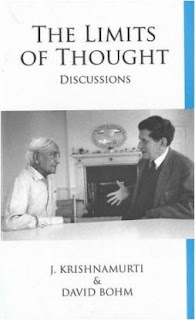
Last month I explored the question “Can tradition cause brain damage?” in a blog.  The post was based on a dialogue between spiritual teacher Jiddu Krishnamurti and physicist David Bohm in the book “The limits of thought”. My blog ended with a brief mention of how the brain damage could get healed as per the dialogue. In this article, I would like to expand on the healing process as JK-Bohm discuss it in the book.

Can the damage be healed at all? JK says, “If it is completely damaged, you can’t do anything about it, you are ready for an asylum. But we are talking of a brain that is not too damaged.”1

What is the first necessity? JK says, “That is the first necessity, that I realize it.” What do I realize? “That whatever the damaged brain does, which is the result of thought and tradition and all the rest of it, will produce further damage.”2

Let me try to explain this part with an example. Let’s say the cultural tradition says that you must become a successful person otherwise your life is a waste or success is necessary for a secure future. So, the thought of becoming successful dominates my life. It involves identifying success parameters like wealth, position, fame, social contribution, etc. And I get caught in the measurement game. I constantly compare what I have (wealth, name, fame) with some gold standard of success, find something that is still missing and strive to get there.

We can extend this to religious tradition as well. JK says, “I have accumulated psychologically as a Hindu; another has accumulated as a Muslim; there are thousands of divisions. Therefore, accumulation in its very nature divides people, and therefore creates conflict.”3

What JK is saying is that the first step is to realize that my thought process is caught in a loop that is the result of the tradition-induced brain damage and it is making the damage worse.  The next thing that may happen is a deep insight which “acts as a tremendous shock or jolt”4 to the brain.

Deep insight into the movement of thought: JK says, “If I have an insight into the whole nature of control, which is measure, that liberates the mind from the burden.”5 “When there is this insight, the damage is undon.”6 However, JK warns, “It (the insight) cannot be invited. It’s like saying – I’ll be attentive in order to receive truth. That’s nonsense.”7

Now, insights are not new to us. When there is a shift of perception while looking at an optical illusion, it is an example of a tiny insight. Many of us also experience a small jolt when we realize a belief, we held for a long time is false. For example, Santa Clause is a fiction, or ghosts don’t exist. Could a deep insight JK is talking about bring a significant change in the brain? Yes, it is possible. Unfortunately, there is no formula or method for getting the insight.

Don’t be concerned with truth: Should I strive for such a deep insight into truth? JK says, “Don’t be concerned with truth, you don’t know what it means. Be concerned only with (thought-created) reality and its distortions. To be free of distortions, just observe the distortions, don’t resist them, just observe them. That observation needs (attentional) freedom and that freedom and the observation will give you energy to push away the distortions.”8 A distortion typically manifests as a disturbance such as fear, anxiety, stress, anger, blame, guilt, etc.

To summarize, we need attentional freedom to watch the movement of thought. It is important to observe the movement especially when there is a disturbance in the form of fear, anxiety, anger, etc. This observation may cultivate the ground for a deep insight to sprout into the meaninglessness of the whole nature of control and measurement thought is caught up in. The deep insight would heal the brain. There is no formula or method for the insight.

Source:

1.       “The limits of thought”, J. Krishnamurti and David Bohm, Krishnamurti Foundation India, 2013, page 94.

2.       “Limits of thought”, Page 94

3.       “Limits of thought”, Page 123

4.       “Limits of thought”, Page 94

5.       “Limits of thought”, Page 106

6.       “Limits of thought”, Page 108

7.       “Limits of thought”, Page 52

8.       “Limits of thought”, Page 26

Monday, February 28, 2022

Can tradition cause brain damage?


“Tradition is a form of brain damage” – is what physicist David Bohm and spiritual teacher Jiddu Krishnamurti agree upon in one of their dialogues in the book “The limits of thought”1. A few months ago I got an opportunity to facilitate a reading-and-reflection session on this dialogue and this sentence created discomfort among a few of the participants. They had valid points. Neither Bohm nor Krishnamurti was a neuroscientist. On what basis are they making such a claim? And neuroscience has advanced significantly in the last fifty years since they had this dialogue. Does it support it now? Let’s explore it in this article.

Let’s begin with the dialogue and then look at it through a neuroscience lens. Here is an excerpt from the dialogue:

DB: It occurred to me that tradition is a form of brain damage.

JK: I agree.

DB: Any tradition, good or bad, makes people accept a certain structure of reality, very subtly, without their realizing they are doing it, by imitation, or by example, or by words, just by statements. So very steadily the child builds up an approach in which the brain attributes things which are in the tradition to a reality which is independent of tradition. And it gives it tremendous importance. Tradition has real effects of all sorts, which may even be valuable in some ways. But at the same time it conditions the brain to a reality, which is fixed.

A person may look at that reality and say, “That’s reality, I‘ve got to keep my feet on the ground.” But this ground has been created by tradition, by thought; it is no ground, it has nothing under it at all. It is sustained and nourished by this damaged brain, which is unable to get out of that circle.

Now, let’s turn to a current neuroscience perspective.

Typically, we associate brain damage with some kind of lesion, some physical damage to the structure of the brain. However, that is a limited view of brain damage. According to Karl Friston, a leading neuroscientist, there are two kinds of brain damages2. One is anatomical and the other is functional. He uses radio as a metaphor to illustrate the difference. Anatomical damage is like cutting off the wires in radio, while functional damage is equivalent to transistors becoming dysfunctional. A transistor is dysfunctional when the message passing through the wires gets broken. In neurobiology, such a failure is called neuromodulatory failure when the messages passed through neural synapses are not gated and/or weighted properly. This results in loss of gain control meaning loss of control in excitation and inhibition of various signals.

As Friston articulates, when the gain control is broken, it results in strengthening false beliefs because the inferences based on the sensory information get compromised. For example, should I carry an umbrella today? This question would be answered based on the weather forecast and the likelihood of rain. When beliefs become rigid, the information passing mechanism becomes dysfunctional and incoming information related to rain is either suppressed or considered unreliable similar to a transistor malfunctioning. So I may end up carrying an umbrella no matter what.

Perhaps what Bohm-Krishnamurti are suggesting is that tradition has the capacity to make certain beliefs so strong that they are no longer amenable for update based on contextual information such as weather forecast. Beliefs related to what dress to wear or not wear, what to eat or not eat, what rituals to carry out, whom to marry or not marry may become so rigid that they suppress the passage of contextual information.  They are treated as true and fixed no matter what. As far as certain beliefs are concerned, the brain becomes dysfunctional, fixed, and context-insensitive.

Thus tradition may cause functional brain damage. What Bohm-Krishnamurti say in the dialogue is that the damage may or may not be permanent. What could heal such damage? Krishnamurti suggests that perception or insight into the whole belief structure, its rigidities and how it is operating, in the form of thought, being stuck in a grove, may heal the brain. I am not aware of any scientific research supporting such a claim. However, work such as that of Catherine Kerr, supports a milder form of this claim. That is, a practice of shifting attention away from thinking into body sensations and breathing may result in making the neuromodulation mechanism more flexible. That is, it may improve the quality of information flow through the neural pathways.

Source:

1.      “The limits of thought”, J. Krishnamurti and David Bohm, Krishnamurti Foundation India, 2013, chapter 5 “Tradition and truth”, page 84. This dialogue happened on August 6, 1975, in Gstaad, Switzerland.  Bohm suggests that “Tradition is a form of brain damage” at 6:13 in the audio

2.      Dysconnection hypothesis of schizophrenia”, August 10, 2017, In this video Karl Friston explains the nature of mental disorders and the possibility of a therapeutic cure of schizophrenia.

Friday, December 24, 2021

David Bohm’s matter-energy-meaning equivalence proposal through six examples


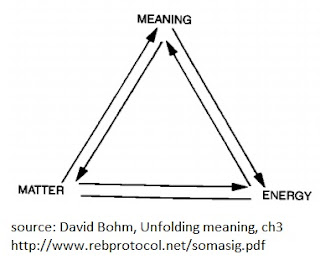
Mind-matter duality vs non-duality has been debated by philosophers and mystics since antiquity. However, scientists entered the discourse only recently. Hundred and fifteen years ago (1905) Einstein proposed matter-energy equivalence in a rigorous manner. It took thirty years to verify it experimentally. A few years ago I came across an extension of this equivalence that includes meaning along with matter and energy in a book “Unfolding meaning” (1985) which is an edited transcript of a weekend dialogue with David Bohm in 1984 in England (See the above figure). Bohm’s proposal of matter-energy-meaning equivalence was not a rigorous scientific presentation. However, it used scientific results as metaphors to explain it in an intuitive way. In his proposal, Bohm also puts meaning as more fundamental than matter and energy. A few years later (1990) John Wheeler, a towering figure in theoretical physics, proposed “It from bit” i.e. “All things physical are information-theoretic in origin”. Since then, over the past thirty years, this paradigm i.e. everything is meaning (or its close cousin - information) has gained momentum among the scientific community (e.g. check out Robert Kuhn episode "Does information create cosmos?"). In this article, I would like to briefly present Bohm’s proposal in his own words through six examples from his article “Meaning and information” (1989). And in the future, I hope to look at how others have explored this paradigm.

----Bohm’s words------

Meaning is the essence of reality. Meaning is inexhaustible. There is no limit to meaning. There is no fixed meaning. All meaning is ambiguous; it depends on the context, as the context changes so does the meaning.

Meaning is the activity of information. Any form to which meaning can be attributed may constitute information. This is generally potentially active, and may become actually active when and where there is a receiver which can respond to it with its ‘own energy’.

Six examples:

(1)    The form is held in silicon chips, which have very little energy, but this form enters into the much greater energy of overall activities of the computer and may even act outside the computer e.g. in a ship or an airplane controlled by an automatic pilot guided by the information in radar waves.

(2)    DNA molecule constitutes a code and the RNA molecules ‘read’ the code and are thus ‘informed’ as to what kind of proteins they are to make. The form of DNA molecule thus enters into the general energy and activity of cell. At any given moment, most of the form is inactive, as only certain parts of it are being ‘read’ by the RNA, according to the stage of growth and circumstances of the cell.

(3)    When the form of a road sign is apprehended in the brain and nervous system, the form is immediately active as meaning e.g. if the traffic sign says ‘stop’, the human being brings the car to a halt.

(4)    A more striking example is that of a person who encounters a shadow on a dark night. If this person’s previous experience is such as to suggest that there may be assailants in the neighbourhood, the meaning of an assailant may be immediately attributed to this form. The result will be an extensive and powerful activity of mind and body, including the production of adrenaline, the tensing of muscles, and an increase in the rate of the heart. But if on closer inspection, this person sees further evidence indicating that it is only a shadow, all this activity stops, and the body and mind becomes quiet again.

(5)    According to the quantum theory, a single particle such as an electron shows wave properties as well as particle-like properties. Hence, a particle must be understood in terms of both the particle and the wave field which always accompanies the particle. This Schrodinger wave does not act like, for example, a water wave on a floating object to push the particle mechanically with a force proportional to its intensity. Rather, a better analogy would be that of a ship or aeroplane on automatic pilot guided by the information in the radar waves. Similar to radar waves, the waves associated with a particle contain active information.

(6)    For a collection of particles, there is a common pool of active information. This can be most clearly seen in the superconducting state of electrons in a metal. This is state that may arise at very low temperatures, in which an electric current flow indefinitely without friction. In this state, the common part of information induces an organized and coordinated movement of electrons resembling a ballet dance, in which the particles go around irregularities and obstacles without being scattered.

As the temperate is raised, however, the state of the system changes in such a way that the property of superconductivity disappears. The explanation for this is that the Schrodinger wave field begins to break up into independent factors representing separate pools of information that apply to similar subsystems and eventually at high enough temperatures, to the individual particles themselves. It is as if, in the ballet, the dancers begin to break up into separate groups that are guided by different ‘scores’ until eventually each individual is doing his or her own dance, unrelated to those of others. The coordinated state of movement to disappears, and the electrons behave more like disorganized crowd of people than like an orderly group of ballet dancers.

Meaning for whom? Meaning is for itself. Ultimately there is nobody to whom meaning is “for”. Rather, meaning is the basic quality of reality.

Intelligence is part of the process of perception of meaning. Creativity is related to a constant discovery of new meanings.

---- end of Bohm’s words------ 

There is more to Bohm’s proposal than what is visible in these examples. For example, Bohm talks about how meaning flows from gross level in the matter to subtler levels and vice versa. For more information, please check out the references below.

I hope to explore how others have pursued this paradigm of treating information or meaning as the essence of reality. Your suggestions are welcome.

References:

  1. Unfolding meaning: A weekend dialogue with David Bohm”, David Bohm, Routledge, 1985 (2005 digital edition). Chapter 3
  2. Meaning and information”, David Bohm, from the book, “The search for meaning: The new spirit in science and philosophy”, edited by Paavo Pylkkanen, Crucible, 1989. All the six examples given above are from this article.
  3. A change of meaning is a change of being”, Dialogue between David Bohm and Renee Weber, undated. This is one of my favorite interviews of Bohm.
  4. A new theory of relationship of mind and matter”, David Bohm, Philosophical Psychology, 3:2, 271-286, 1990.
  5. The philosophical and scientific metaphysics of David Bohm,” William Seager, Entropy, 20, 493, 2018. This article looks at Bohm’s metaphysics critically. It points out that Bohm’s “active information” is different from Shannon information commonly used in scientific literature.

Sunday, December 19, 2021

2 ways of learning to fail with comfort

Failing can’t be a comfortable event. Or so I believed for a long time. Until I came across a suggestion from Nassim Taleb thirteen years ago (December 2008) which said, “Learn to fail with pride, comfort and pleasure”. My initial reaction was disbelief. And yet I decided to take the suggestion very seriously and kept on testing it as a hypothesis. Over the past decade, I discovered that I don’t experience pride and pleasure when things don’t work out. However, I felt it is possible to be comfortable with failing. And the experimentation involved trying 2 broad approaches: (a) protecting against the downside, and (b) subtracting expectations both of which came from Taleb himself. So here is a short reflection on what these approaches meant for me. But let me begin with the context.

Nassim Taleb’s interview was published in December 2008 issue of McKinsey Quarterly. It was related to Taleb’s book “The black swan: The impact of the highly improbable” which got published in 2007 and became a big hit especially during the financial crisis of 2008. In this interview he was asked, “What would your ideas look like in practice for, say a manufacturer?” And Taleb said, “If risk doesn’t cost you a lot, take all the risk you can. Do more trial and error. Learn to fail with pride, comfort and pleasure.” And then he added, “But try to have less downside exposure by building more slack into your system through redundancy, more insurance, more cash, and less leverage. Imagine a shock. What will happen if there’s a shock? How many months could you keep operating?”  

When I read Taleb’s interview in December 2008, I was self-employed for a little over two years. My consulting pipeline was dry and with the impending downturn there was failure written all over. I was uncomfortable and anxious, far away from being proud and pleasurable. We had moved into a new apartment and there was a burden of housing loan. And hence, I was both sceptical and curious about “learning to fail with pride, comfort and pleasure”. It didn’t take me much time to drop the “pride and pleasure” part as unnecessary and stick to just “learn to fail with comfort”. Here is what it meant for me to experiment with the two approaches:

Protect against downside: Over the next few years, I did following:

  • Paid off the housing loan and increased the cash position. I was lucky to have some stocks from my previous employer that helped in this process.
  • Wore helmet while cycling and seat-belt while driving 😀
  • Took data backups seriously and it became a ritual. Laptop crashed a few times but never became a big issue.
  • Took protecting customer’s confidential information very seriously. Similarly, while building on others’ ideas, I made sure I attribute credit to the source of ideas. Learned to make modest claims about what management of innovation can achieve in an uncertain world.
  • Took low-cost experimentation very seriously. This meant offering different open workshops in hotels and testing which ones are more attractive to customers. Many of them didn’t last and it didn’t hurt at all. Started presenting my ideas through blogs which was and is free and I find it to be a good platform for early testing of ideas.

Subtract expectations: No matter how much one tries to protect oneself, with helmet, cash, insurance or a vaccine, an accident or a virus can spring unexpected surprises. And the setback could feel like a failure. This is where we turn to the question: Why expect at all that life will be smooth? In fact, can one routinely anticipate disruptions?

Seneca, a first century Stoic, is one of Taleb’s heroes in the book “Antifragile: Things that gain from disorder”. Seneca used to mentally write-off all his possessions before going to bed as if he were to be in a shipwreck. If he still had them when he woke up, it was a bonus.  Seneca was a shipwreck survivor and perhaps he had experienced the fragility of life first-hand. Taleb quotes Seneca, “He is in debt, whether he borrowed from another person or from fortune.”

Thus expectations or desires are also a kind of debt which turns into obligations to be fulfilled. When not fulfilled it feels like a failure. “Oh, I couldn’t buy the car I wanted so badly.” But subtracting expectation debt is not as easy as paying off monetary debt. Expectations can be deep-rooted and subtle. We can’t just subtract the waves on the ocean, can we? So this is what I learned from spiritual teachers like Jiddu Krishnamurti, David Bohm and Eckhart Tolle that I could apply it my context.

An expectation gets subtracted when it is seen as meaningless. And to see expectations in action one needs to learn to watch the movement of thought while thinking. This movement is subtler than the movement of breath. Moreover, expectation per se is not bad. It is the force behind the expectation turning it into an absolute necessity that makes failing dreadful. Over the years, watching the movement of thought has become a second nature for me. However, thought is a sophisticated process and it is extremely good at creating self-deception. So watching the movement of thought is a lifelong learning process.

Does it mean I have no expectations? No. I do make plans – some short term (course teaching plan) and some long-term (consulting focus for the next few years). Earning a livelihood is still important. However, if things don’t go as per the plan, and they invariably do, it doesn’t surprise me. In fact, I anticipate and watch out for surprising signals, both positive and negative and course correct if necessary. And failing has felt normal and comfortable for the past several years.

To summarize, protecting against downside exposure and subtracting expectations are two ways of learning to fail with comfort. Subtracting expectations needs alertness to watch the movement of thought and recognize the meaninglessness of expectations when they don’t make sense anymore.

Friday, October 15, 2021

My 3 favorite verses from Bhagavad Gita

Bhagavad Gita is an ocean and I am no expert on it. However, from time to time I come across a verse from Gita which makes me curious and I study it. Over the years, I have become fond of certain verses. Here I present 3 of my favorite verses.

      1.      This is verse 2.28.

अव्यक्तादीनि भूतानि व्यक्तमध्यानि भारत।

अव्यक्तनिधनान्येव तत्र का परिदेवना ॥2.28॥

avyaktadeeni bhootani vyaktamadhyani bharat

avyaktnidhananyev tatra ka paridevana ||2.28||


Before birth, beings are unmanifest;

between birth and death, manifest;

at death, unmanifest again.

What cause for grief in all this?

(translation: Bhagvad Gita, A new translation, Stephen Mitchell, 2000)

This verse is interesting to me because of its counter-intuitive proposal. We are all familiar with the forms in and around us such as mountains, trees, clouds, living beings, etc. This world is sometimes called the manifest. We also know of subtler forms such as programs present inside your smartphone or DNA code present inside every cell of your body or beliefs we carry in our memory. This verse suggests that the manifest world also exists in such a subtle yet unmanifest state. Now the question is, which is more fundamental, the manifest or the unmanifest or both are equivalent? This verse proposes that the unmanifest is more fundamental. It is from the unmanifest, the manifest emerges and after the form dissolves it goes back to the unmanifest again.

In the case of the software program inside the smartphone, this is not difficult to see. When you start an app such as a video player, the program for playing video gets activated and when you exit the app, the program remains in the inactive state. However, if you dismantle and open the phone or even break it, there is nothing in there that you can touch and say, “This is the video playing program.” The program exists in a subtle form that can’t be touched or felt. Programs not only drive smartphones but also drive giant airplanes and large plants.

Perhaps we could say the same thing for our beliefs. Every moment, according to what the moment means to us, certain beliefs get activated.  They give rise to thoughts, which in turn give rise to actions and when at another moment the meaning changes, these thoughts go away and those beliefs remain in an inactive state. Neuroscientists haven’t figured out a way of pointing to a set of neurons and say that this is the belief. The programs and the beliefs are examples of unmanifest and the video player, the airplane and the human body are examples of the manifest.

The verse suggests that each of us came from an ocean of the unmanifest and we would go back to the ocean after death. And then asks the question: Why worry?


2.     This is verse 13.29 

प्रकृत्यैव च कर्माणि क्रियमाणानि सर्वशः।

यः पश्यति तथात्मानमकर्तारं स पश्यति॥13.29||

 prakrtyaiva cha karmaNi kriyamaNani sarvashah |

yah pashyati tathatmanamakartaram sa pashyati || 13.29||

(My translation:)

All actions are performed by inbuilt tendencies

One who sees that self is non-doer sees

The phrase that first attracted me to this verse is यः पश्यति स पश्यति (yah pashyati sa pashyati, one who sees, sees). It is suggesting that seeing clearly is enough. It doesn’t say, “One who sees, does good” etc. Now what does one see? One sees that our tendencies are expressing themselves into various actions and that there is no independent self acting. Like the previous verse, this is counter-intuitive. It is not our everyday experience. It feels as though I am making decisions and acting. Of course, there are times when we feel overpowered by our tendencies – overeating, oversleeping, over-reacting, worrying, etc. But other than that it feels as though I am in command.

To me, a self-driving car is a good metaphor that may help us see what this verse is trying to suggest. A self-driving car driven by a shared program carries tendencies based on past experiences, not just of that car but other similar cars as well. And is there an independent entity driving the car? No. The program is shared and the map is shared. Perhaps we are like self-driving cars, there is no one in the driver’s seat.

3.     Verse 17.3

सत्त्वानुरूपा सर्वस्य श्रध्दा भवति भारत।

श्रध्दामयोSयं पुरुषो यो यच्छ्श्रध्दः स एव सः॥17.3||

 sattvanuroopa sarvasya shraddhaa bhavati bharat

shraddhamayo S yam purusho yo yachshraddhah sa eva sah ||17.3||

(My translation:)

Beliefs exist according to one's nature, Arjuna

An individual is a concoction of beliefs, whatever his beliefs, he is that

The phrase that attracted me to this verse is यो यच्छ्श्रध्दः स एव सः (yo yachshraddhah sa eva sah, Whatever his beliefs, he is that). It makes a very strong statement – You are your beliefs. Like previous verses, this feels counter-intuitive. I feel my beliefs are just one aspect of me. But beliefs are not me.

You could say, your body is not a belief. But neuroscience has revealed that one could feel pain/itch in a body part/limb that doesn’t exist. You could say, my breathing is not a belief, it is a fact. Alternately, one could say that necessity of breathing is a belief held by the body-mind for its survival that is just playing out. As neuroscientist Karl Friston puts it, “Each individual is a hypothesis or model of what should occupy this ecological niche, and must compete for selection under pressure from the environment”.

Perhaps you could see the connections between all three verses. We can look at a set of beliefs like a shared program that is getting updated based on new experiences. And life is just a play of that shared program in response to changing context. The shared beliefs or the unmanifest expresses itself into different forms including living forms. A form is nothing but shared beliefs in action embedded in a context.

Hope these verses made you reflect. You may not see it the way these verses suggest right now. But sometimes it is worth looking at them as hypotheses. Hope you give them a fair try.

image credit: iskondwarka.org

Saturday, June 5, 2021

My key takeaways from Katha Upanishad

Investigating the “illusion of time” hypothesis is an important part of the mindfulness process and I explore it in chapter 7 of my mindfulness book. In Sanskrit and in many Indian languages the word kaal (काल) means both time and death. Hence, Katha Upanishad (or Kathopanishad) which contains a dialogue between Nachiketa, an inquisitive boy and Yama, the God of death has been of interest to me. I had read the English translations a few times. Last year, I tried to read it in Sanskrit. I used the Sanskrit online dictionaries and also listened to 30 of 47 discourses by Swami Tejomayananda of Chinmay Mission last year. Here are my key takeaways from what I have read so far and what my understanding is of these verses. I am sure, like any art form, I might find new meanings and nuances when I read it again.


1.      What is the state of the world?

Verse: 1.2.5

अविद्यायामन्तरे वर्तमानाः स्वयं धीराः पण्डितं मन्यमानाः ।
दन्द्रम्यमाणाः परियन्ति मूढा अन्धेनैव नीयमाना यथान्धाः ॥ ५ ॥ 
 
avidyāyāmantare vartamānāḥ svayaṃ dhīrāḥ paṇḍitaṃ manyamānāḥ |
dandramyamāṇāḥ pariyanti mūḍhā andhenaiva nīyamānā yathāndhāḥ || 5 ||

Living in the middle of ignorance and regarding themselves as intelligent and learned, the ignorant go round and round, in many crooked ways, like the blind led by the blind.


2.      Why is the world like this?


पराञ्चि खानि पराङ्पश्यति नान्तरात्मन् । (part of verse 2.1.1)
parāñci khāni parāṅpaśyati nāntarātman |

Sense organs are out-going. Therefore, one sees outside and not the atman within.

And the first line of the next verse (verse 2.1.2) 

पराचः कामाननुयन्ति बालास्ते मृत्योर्यन्ति विततस्य पाशं ।
parācaḥ kāmānanuyanti bālāste mṛtyoryanti vitatasya pāśaṃ | (verse 2.1.2) 

The ignorant pursue external objects of desire; they get into the meshes of widespread death.


3.      What is futile?

Part of the verse 2.1.2 tells what is futile:
ध्रुवमध्रुवेष्विह न प्रार्थयन्ते

dhruvamadhruveṣviha na prārthayante 

(Wise) do not wish for permanence from that which is impermanent.


4.      What to do? (1)


आवृत्तचक्षुः (āvṛttacakśuh)i.e. Turn eyes (attention) inwards (Part of verse 2.1.1)

And observe that (verse 1.3.10)


इन्द्रियेभ्यः परा ह्यर्था अर्थेभ्यश्च परं मनः ।
मनसस्तु परा बुद्धिर्बुद्धेरात्मा महान्परः ॥ १० ॥

indriyebhyaḥ parā hyarthā arthebhyaśca paraṃ manaḥ |
manasastu parā buddhirbuddherātmā mahānparaḥ || 10 ||

Meaning is superior to the sense organs, underlying tendencies or beliefs are superior to the meaning, discerning intelligence (vivek-buddhi) is superior to the beliefs and underlying essence (atman) is superior to the intelligence.

5.      What to do? (2) 

Verse 1.3.14

उत्तिष्ठत जाग्रत प्राप्य वरान्निबोधत ।
क्षुरस्य धारा निशिता दुरत्यया दुर्गं पथस्तत्कवयो वदन्ति ॥ १४ ॥
uttiṣṭhata jāgrata prāpya varānnibodhata |
kśurasya dhārā niśitā duratyayā durgaṃ pathastatkavayo vadanti || 14 ||

Arise, awake; having reached the great, learn; the edge of a razor is sharp and impassable; that path, the wise say, is hard to go by. 


My summary: Wake up, are you pursuing only external objects? Are you leading a meaningless life? Are you wishing permanence in impermanent? Turn your attention inwards and watch the subtle movement of thought. Are you reactive all the time? Is there any discernment i.e. questioning of beliefs? Be alert and watch.

Image source: karunagyoga.in