Sunday, August 31, 2014

Four approaches to problem solving


Car breakdown? Internet not working? Boss or spouse upset? Garbage everywhere? Long commute times? Corruption? Poverty? Everyday, we experience problems at different levels and of varied complexity. Some, like car problem, appear solvable, some like, commute time appear more difficult to solve and some others like corruption / poverty appear hopeless. Nevertheless, problem solving has fascinated mankind for centuries. From Francis Bacon who championed inductive methods to Buddha who championed meditative methods various people have proposed different approaches to solve problems. Here is an attempt to classify these approaches into 4 categories – system centric, problem centric, solution centric and solver centric approach. I will argue at the end that as human dimension associated with the situation gets more complex, we need to use more of solution and solver centric approaches.

To simplify things, I have considered the process of going from problem definition to hypothesis generation (or solution creation). And hence, I have kept the steps of problem definition and the hypothesis validation (experimentation) out of scope. Most of the times, problem solving is an iterative process where problem (re-) definition, solution creation and experimentation get repeated until one is satisfied. Thomas Edison epitomized this method by running tens of thousands of experiments to get his light bulb right.

Four approaches to problem solving:

System centric: Tata Nano is the result of questioning the position, material and various properties of car’s components. For example, engine’s position has moved back from front. Plastic was given a serious consideration as a body material before abandoning it because it didn’t fit in the budget. In the early stages of conceptualization the role of doors was questioned.  In the systemic centric approach, a system is looked upon as a combination of various sub-systems. And then the arrangement of sub-systems (and its sub-systems) gets questioned and changed to meet certain constraints like cost, performance etc. TRIZ methodology and its variants like Systematic Inventive Thinking (SIT) are examples of system centric approaches. For further study, SIT’s five thinking tools (subtraction, multiplication, division, task unification and attribute dependency) is a good place to start.

Problem centric: Malaria has been one of the deadliest diseases for mankind. It may have contributed to the decline of Roman Empire. However, once it was known that it is spread through mosquitoes, its arrest became easier. Bed nets and insect repellents are low cost and yet effective measures to reduce the risk of malaria. Root Cause Analysis helps us find the root cause of the problem and then address it. Techniques like fishbone or Ishikawa diagrams and asking five-why’s have been developed to help analyse root causes. This site shows how root cause analysis is applied to various famous failures in various industries like aviation, healthcare, business, environmental, legal etc. For example, this article presents the application of repeated “Why” questioning to arrive at root cause(s) of devastation due to Hurricane Katrina.

Solution centric: By the time Gyanesh Pandey realized that Jatropha based biodiesels based approach won’t be a viable approach, he had already spent significant portion of his pension fund and five years in iterative experimentation. He was struggling to hold on to his dream of electrifying rural India and had run out of ideas. In a chance meeting, he came across a gasifier based electrification technology being used in forty villages in Bihar. He spent a month-and-a-half at one of the plant studying it and improved it further. This led to Husk Power Systems, a venture Gyanesh co-founded that sells gasifier based power generators that supply electricity several off-grid villages in North East India. Note that Gyanesh’s breakthrough happened when he looked at a solution rather than the root cause of the problem. Hence this approach is called solution centric approach.

As the social system becomes large and complex (like rural India), it becomes more difficult to do root-cause analysis. Nassim Taleb calls such systems high causal density systems. The number of variables which are affecting the system is very high – perhaps thousands, perhaps millions. Hence, to solve a problem, it makes more sense to start with “what is already working in the same setting” (a solution). These are referred to as “bright spots”. The idea is to focus on scalable bright spots. The psychotherapy method called Solution Focused Brief Therapy (SFBT) focuses on bright spots as a starting point. Similarly, an approach called Positive Deviance advocates solving social problems by scaling bright spots. Chip & Dan Heath advocate “Follow bright spot” approach in their book “Switch:  How to change things when change is hard”.

Metaphor (or analogy) is another powerful solution centric method of solving problems. A metaphor tries to create an equivalence between two seemingly disconnected concepts by asking, “Why can’t this be more like that?” For example, McDonalds and an eye hospital (Aravind Eye Care), moon and apple (Newton & gravity), water in the tub and water in the stream (Hellen Keller’s first breakthrough concept) etc.

Solver centric: In 1993 when Dr. Kiran Bedi became IG(Prison) of Tihar Jail, she asked an interesting 
question – Why can’t a jail be more like an ashram – a spiritual retreat for prisoners? Soon, an experiment was conducted in which 96 inmates and 23 jail staff participated in a 10-day Vipassana meditation course conducted within the jail premises. It was a success and since then it has become a regular practice at Tihar. Moreover, it has been introduced in other prisons in India and abroad.

What has meditation got to do with problem solving? A reason why a jail term may not reform a convict because the thought patterns which lead to a wrong-doing are stuck deep inside the mind. Similarly, we are not able to solve a problem because cobwebs of judgments / desire / fear prevent us from seeing the world as it is. The same tape of complaints and labelling is getting played again and again inside our heads most of the time. The only way out is to see clearly the futility of this wasteful involuntary compulsive thinking. All meditation approaches are intended to get one’s attention away from this compulsive thinking. Hence, meditative approaches are solver centric approaches. A practice like dialogue championed by people like David Bohm, Peter Senge and Edgar Schein is also an example of solver centric approach. In a dialogue, the emphasis is placed in clarifying one’s own assumption rather than judging others’ comments.

Which is the best approach? Of course, each approach is relevant in some context and you may need to combine them as well. However, I feel that as the social complexity of a problem increases, the role of solution and solver centric approaches increases. My limited experience of working with organizations over the past eight years tells me that solution and solver centric approaches are under emphasized and under-utilized. Hope to see more people using them in future.

Monday, August 18, 2014

An idea presentation template based on Steve Jobs’ iPod launch speech in 2001


This nine minute clip showing Steve Jobs launching iPod for the first time in 2001 is one of my favourite videos. I have watched it dozens of times, had several discussions on it in my innovation workshops, and referred to it in our book as well. Somewhere along with way a thought came – can we create a simple template from this video that others may find useful while presenting their ideas? In this article, I would like to present the template which came as a response to that question. Several of my workshop participants have found it useful and hence thought of sharing it.

To appreciate the template, let’s break the presentation into three parts: Why, What and How. In this presentation, they answer the questions (1) Why music? (2) What is iPod? (3) (Let me show you) How it fits into my pocket.

Why music? In the “Why” part, Jobs tells us why this space of digital music was important to Apple at that juncture. Through following table, Jobs communicates the options available, associated trade-offs and the position Apple had taken (to go for hard drive option).

What is iPod? In the “What” part, Jobs presents brief description of what iPod is – an MP3 music player, has CD-quality music and it plays all of the popular open formats of the digital music, holds 1000 songs and fits in your pocket. He unleashes the tagline – Your entire music library fits into your pocket. He articulates the three things unique about the iPod – storage, portability and design. He also highlights several user scenarios such as iPod running out of charge. Note how Jobs covered a few what-if scenarios. E.g. What-if I am on the road and my battery is dead? What-if I have to transfer CD to iPod?

Let me show you: The easiest way to build credibility is to showcase a key feature of your idea. Here Jobs shows the picture of iPod on the screen (design) and then shows how the iPod fits into his pocket (portability).

The three aspects of the this presentation: Why-What-How can be extended to any idea. Following picture illustrates the template.


The template incorporates three core communication design principles: curiosity flow, concreteness and credibility. Curiosity flow is introduced through Why-What-What-if-How questions. Concreteness is ensured through what-if scenarios, by showing experiential imagery like the deck of cards and by showing the demo. Credibility is enhanced by showing a trade-off analysis table and by showing a working demo. Note that unlike Steve Jobs establishing credibility is the most difficult of the three aspects for most idea presenters.

Here is an example where the template is applied to an idea of starting “A Mexican restaurant in Sarjarpur Road area” (where I live). It is a fictitious example and hence used for illustration purpose only.

Saturday, July 12, 2014

Three practices from Eckhart Tolle’s teaching that I find useful

On Guru Poornima, I would like to reflect upon three practices from Eckhart Tolle’s teaching that I find useful. First, let’s note that the domain of spirituality is full of paradoxes. For example, Eckhart says, “You will need time until you realize that you don’t need time to be who you are1”. Every practice inherently involves time and is useful only until you realize that you don’t need it. Looks like presently I need time and also a practice. Here I present three practices corresponding to 3 A’s: Attention, Alertness and Acceptance. They are inter-related but each one carries a different flavour.

Shift attention away from thinking: I find this the simplest of the three practices to get started. It was a great joy to discover that I can shift my attention away from the stream of thinking - at least some times. Where do you put the attention? In the current step, whatever that is. For example, sometimes, I am able to put attention in the feet while walking, in the knees while jogging, in the gums while brushing etc. One thing you are certain to be doing at any moment is breathing. Hence, that is another place where I put my attention. There are times when I close my eyes and shift attention to all the sounds I hear – kids playing, construction work, truck honking, cooker whistling, birds singing etc. Many times when the attention is shifted away from thinking, I am able to hop off the train of thought. Until, of course, I jump on to another train later.

How often should we do this practice? Ideally, all the time. No matter how important your goal is, Eckhart says, “Give your fullest attention to the step you are taking at this moment.2” Overall, this practice works fine for me when the voice in the head is relatively light. But it doesn’t work in situations where the reaction takes off suddenly. That is when we turn to the second practice: Alertness.

Be alert in separating situation vs response: There are situations in which you are more prone to get anxious, angry, irritated etc. For me, a situation that ticks me off is when I am standing in a queue and someone cuts in. It is almost like the person cutting the queue is pressing a button in my head. Each of us has buttons which get pressed in certain situations and that triggers a strong negative emotion. Interesting part here is that we are already aware of some of these situations which make our buttons active and ready-to-be-pressed. If not, like me, you can keep a diary and make a note of them. The idea is to become alert and watch out for the emotion to arise when we enter these button-pressing situations.

What does the alertness do? Well, it creates a gap between the situation and its response in our head. Note that the person cutting the queue is not actually pressing the button. The thought which comes as a response to the queue-cutting presses the button. The alert attention separates the situation from the response and that weakens the response. Eckhart says, “The primary cause of unhappiness is never the situation but your thoughts about it. Separate thoughts from the situation which is always neutral.3

Accept the situation - then act: No matter how alert you are, there are going to be times when you are caught off-guard. Like it happened when a store keeper told me that the fifty rupees bill I gave him was fake. It meant someone had duped me. Immediately a commentary started running in the head, “How did you get fooled so easily? Why didn’t you pay attention while receiving the change?” – mostly useless thoughts. At this stage, it helps to pause and accept the situation first and say “I have a fake fifty rupees bill.” And then ask, “Is there anything I can do to change the situation, improve it or remove myself from it?4” If so, take appropriate action. If no action is possible then just surrender to the situation. In this case, I didn’t remember where I got the bill from. And hence I decided to just move on. That slowed down the commentary and eventually stopped within the next few minutes. Without the acceptance the commentary carries a power of running for a long time.

I feel acceptance is the hardest of the three practices. We realize it when we try to accept the loss of our job, a relationship or a loved one. We put ourselves into a “loser” or a “victim” role and the internal resistance engine fires full steam. It sucks the energy from our attention. Acceptance slows down the resistance engine and releases energy for more useful purposes.

Eckhart says, “Whatever the present moment contains, accept it as if you had chosen it. Always work with it, not against it.5

In summary, I find the three practices corresponding to Attention-Alertness-Acceptance very useful in day-to-day activity. I am grateful to Eckhart Tolle for making these insights accessible to us through his books and videos.

Source:

1.      “Stillness speaks”, page 54
2.      “Practicing the power of now”, page 36
3.      “The new earth”, page 96
4.      “Practicing the power of now”, page 120
5.      “The power of Now”, page 29

photo source: wikipedia.org - photo by Kyle Hoobin

Sunday, June 22, 2014

My 3 take-aways from “Buddhism and Modern Psychology” course

Over the past few months, I participated in “Buddhism and modern psychology” course taught by Prof. Robert Wright of Princeton at Coursera.org. It wasn’t my first MOOC but it was the first one where I had a buddy-student, my wife Gauri. Having a sounding board made a huge difference, at least to me.

Primary objective of the course was to look at scientific evaluation of Buddhist ideas such as the Four Noble Truths and the concept of no-self (Sunyata). In particular, it explored following two questions: (1) Is Buddha’s diagnosis of human predicament true? and; (2) Is Buddha’s prescription powerful and effective? It didn’t delve into Buddhist ideas such as reincarnation that were not amenable to scientific evaluation. While the course used various experimental results from psychology as a reference point, it borrowed primarily from one branch of psychology called evolutionary psychology.

The question that led Prof. Wright to this course is: Is there a religion that is compatible with modern science? I feel he made a good case for Buddhism through this course. However, I was primarily interested in a much narrower question: Can I build spiritual stamina systematically through a practice such as meditation? I was more interested in experiential learning rather than intellectual understanding – perhaps in the same spirit that Buddha advocated. Here are my 3 take-aways from the course including the as-of-now answer I found to my question.

Buddha as a rebel against Natural Selection: Which recording artist sang the most Buddhist song in the history of popular music? Prof. Wright felt that Rolling Stones vocalist Mick Jagger is a strong contender for his famous song “(I can’t get no) satisfaction”. Buddha has identified perpetual unsatisfactoriness (Dukkha) as a key characteristic of human mind (The first Noble Truth). Whether it is a toy in the childhood or the salary in the adulthood, we don’t seem to have enough. Psychologists refer to a closely related concept called hedonic treadmill.

That makes sense from “selfish gene’s” point of view. Its primary objective is to propagate itself into the next generation. Hence, it is natural to strive to stand out from the crowd or outsmart your competition. Hence, if you overestimate the threats from competitors then that seems fine from natural selection’s point of view. Similarly, if you overly worry over what you will say on your date, then that makes sense too. It is not Natural Selection’s agenda that you see the world clearly.

Buddha made a claim that we can counterprogram our brain to see the world more clearly. As a result, he said, we will reduce and eventually eliminate the perpetual unsatisfactoriness altogether. Moreover, he offered a systematic path to move towards to the goal. That was a bold claim to make 2600 years ago. Hence, Prof. Wright called Buddha a rebel against Natural Selection.

Clinging to impermanent things: Buddha says that the root cause of perpetual unsatisfactoriness is our tendency to cling to impermanent things (Second Noble Truth). Impermanence as a concept is not new to us. We know that everything in nature – clouds, trees, animals, you and I as well as things we make and own such as clothes, phone, car, money come and go. So what’s the big deal here? Well, according to Buddha, the mistake we make is to cling to these objects and make them a part of our “self”. As a result, whenever my car gets a dent, I am hurt.

 Buddha says that just observing this clinging process is itself an important step in reducing the clinging. How do we do it? The idea is to focus our attention inward on the objects in our experience such as sense-perceptions, thoughts, emotions etc. as they arise and pass away. For example, we can put attention on irritation as it arises and subsides. When I did that on some occasions something strange happened. The intensity of the emotion decreased. I found it easier to try this in simple situations like waiting in grocery checkout counter or while stuck in the traffic jam etc. You might say, these are really simple situations. Will this really work in conflicts where we are deeply hurt ? Well, it depends upon whether your spiritual muscle is sufficiently developed. That is where we turn to the systematic practice Buddha recommended.

Mindfulness meditation: Prof. Wright interviewed four Buddhist monks / spiritual teachers and three psychologists during the course. One of the spiritual teachers Prof. Wright interviewed is Joseph Goldstein. Joseph has been practicing and teaching Mindfulness meditation (also called Vipassana or insight meditation) for the past forty years and is a co-founder of Insight Meditation Society. Accordingly to him, Mindfulness involves three things: (1) living in the present moment (as opposed to thinking of past and future) (2) presence of an awareness that watches and; (3) presence of an open and compassionate filter through which this observation happens (as opposed to aversion and greed). Note that this definition does not include any particular sitting posture or a secluded environment. As per this definition you could be meditating while in a meeting with your boss. So why do we associate meditation with the image of sitting cross legged with eyes closed?

Well, it is like practicing in a laboratory environment where we have reduced the number of distractions to the minimum. That makes it easy to get started. In fact, the silent retreats prohibit phones, reading, TV and even talking.  Sometimes the sitting practice is considered analogous to a musician doing scales practice. However, unless you are able to integrate this practice with day-to-day activities, it does not take you very far. Are there any progress indicators in meditation?

Joseph offers an interesting progress indicator. He calls it Noticings Per Minute (NPM). How many things can you notice arising and passing away in a minute? Apparently a novice notices perhaps 10 or 15 things. But as you advance in your practice, your perception is heightened, compulsive thinking has slowed down and your NPM goes way up (perhaps several hundreds). For starters, I have begun to notice the dust on my table J and have begun cleaning it more regularly.

One of the psychologists Prof. Wright interviewed is Dr. Judson Brewer. Brewer is an addiction psychiatrist at Yale. He belongs to a group of scientists who study the science of meditation and investigate if it can be used as a tool to improve life. For example, in a randomized control trial, Brewer and team found that Mindfulness training was twice as effective as the gold standard “Freedom from smoking” in reducing the smoking addiction (see his TED talk). These scientists have used real-time neural feedback from brain during meditation and found out how wandering mind activity can be seen visually. In an unrelated Harvard study (2010) titled “A wandering mind is an unhappy mind”, Killingsworth and Gilbert present the result of a study involving a quarter of million samples from 5000 people in 83 countries representing 86 occupational categories.

In short, based on my limited experience, I feel that it is possible to build spiritual muscle with mindfulness practice. Overall, I felt Prof. Wright did an excellent job in exploring the intersection of two seemingly unrelated areas – spirituality and science. When I experienced the charm of Bodh Gaya and Nalanda last December, I didn’t know it would be just the beginning of a journey. Now it is for me to find a rhythm in my spiritual “jogging” practice.

Sources: Photos: Buddha (from my wife Gauri), Prof. Wright (from his class video), fMRI scan (from Dr. Brewer’s TED talk). Thanks to Gauri for reviewing the post and useful suggestions.

Tuesday, June 17, 2014

Applying “bright spot” approach to “no time for innovation” syndrome

One of the common complaints I get in innovation workshops is as follows – We get many ideas but we don’t get time in our busy schedule to work on them. What can I do? Many times the participants look at me to provide some sort of solution based on my experience. My favourite response is to turn the problem on its head by using the “bright spots” approach and generate options from the participants themselves. It has always generated useful ideas. Here is how.

I first introduce the bright spots approach through a story e.g. How Jerry Sternin approached the malnutrition problem in Vietnam. Then I ask the participants following questions:


Here is a response I gathered from participants in one of the recent workshops:


Some of these situations are not scalable. For example, #1 says, “Challenge has senior management attention”. You don’t have control on whether a particular challenge will get senior management attention. However, some others are scalable. For example, one can pick up a challenge that addresses a pain area for a large number of people in your team (#4). In a team, everybody was spending a lot of time in populating a dashboard which was possible to be generated automatically. When someone proposed a solution to automate the process, everybody backed him up. And the idea got implemented within a month. Similarly, an idea that got push back from manager moved forward when the engineer created a Proof of concept and showed him (#7).

Not everybody finds bright spots approach appealing. However, a few people are always surprised. It is a sudden discovery that a key to the problem they want to solve may be already there in their trouser pocket. At the end of the workshop, I ask for one take-away from each participant. Not surprisingly, “Bright spot” approach comes up as a take-away from at least 3-4 people. 

Think about how you might apply bright spot approach to your nagging problem.

Thursday, May 29, 2014

3 tools I find useful as an innovation catalyst

Over the last seven years, I have been doing my bit in helping my clients innovate more effectively. Their business domains varied from apparel design to aircraft design and from software product development to educational services in social sector. During this journey I ended up using a number of tools – perhaps over fifty. However, I have developed special friendship with some of the tools – primarily due to their usefulness under varied contexts. Here I would like to present 3 such tools which I find very useful in almost any context.

Weighing scale: I am a big fan of weighing scale as a metaphor. It is simple, easily accessible and provides emotion-proof feedback. You weigh the same no matter how angry you are. In contrast, a report based on an annual survey is typically neither simple, nor that easy to re-create and incorporates emotional biases. I suggest innovation dashboards and also get my clients into a dialogue on 5-levels of innovation maturity which are more like weighing scales. Not everybody in the room may agree on whether they are at level 2 or 3 on innovation maturity. However, it creates a useful discussion on what they can do next. For example, if the key challenge is that the average response time for an idea is more than a month, a discussion happens around what can be done to reduce it.

Bright-spot torch: A torch is useful in focusing the attention to a specific area. I use a special type of torch which helps me focus on bright-spots in the organization. Bright spots are things that are already working well in some corner (e.g. see how bright spot led Steve Jobs to iPod). A few weeks back I facilitated a session on writing technical white papers in a client organization. As part of the preparation I tried to gather the technical papers written by the employees in the organization in recent past. None was identified. However, when I asked the same question during the session, one hand got raised. In fact, he told us the story of how he went about preparing for the paper which everybody found useful.

Bright spots are useful because they can tell us a lot about how things work in the same cultural context. They inspire and also give direction. Bright spots are not easy to find because they typically don’t bubble up through status reports. Whether it is interesting prototypes or big bets related to specific technology trends (like cloud or humanoids), chances are high somebody in some corner is working on it or at least thinking about it. Can we zoom in there and find more about it? Perhaps the situation is scalable.

Checklist: Intuition works great when we are doing things we are familiar with. However, when we are trying to change mindset, intuition is not very helpful. Sometimes people are not used to submitting ideas, managers are not used to listening to ideas with an open mind, and senior managers are not used to participating in innovation reviews. In such situations I find checklists very helpful. I propose a checklist whether it is a challenge campaign or an innovation review or even a white paper to be written. For example, here is a sample checklist for running a challenge campaign and here is an author’s checklist for writing a white paper. My customers find it useful. In fact, I have earned some brownie points by creating a checklist for groceries which we use at home. A checklist is more helpful when intent to improve things exists. You need different set of tools to generate intent (e.g. a challenge book). It is not surprising that each chapter in our book “8 steps to innovation” has a checklist at the end.

Monday, May 26, 2014

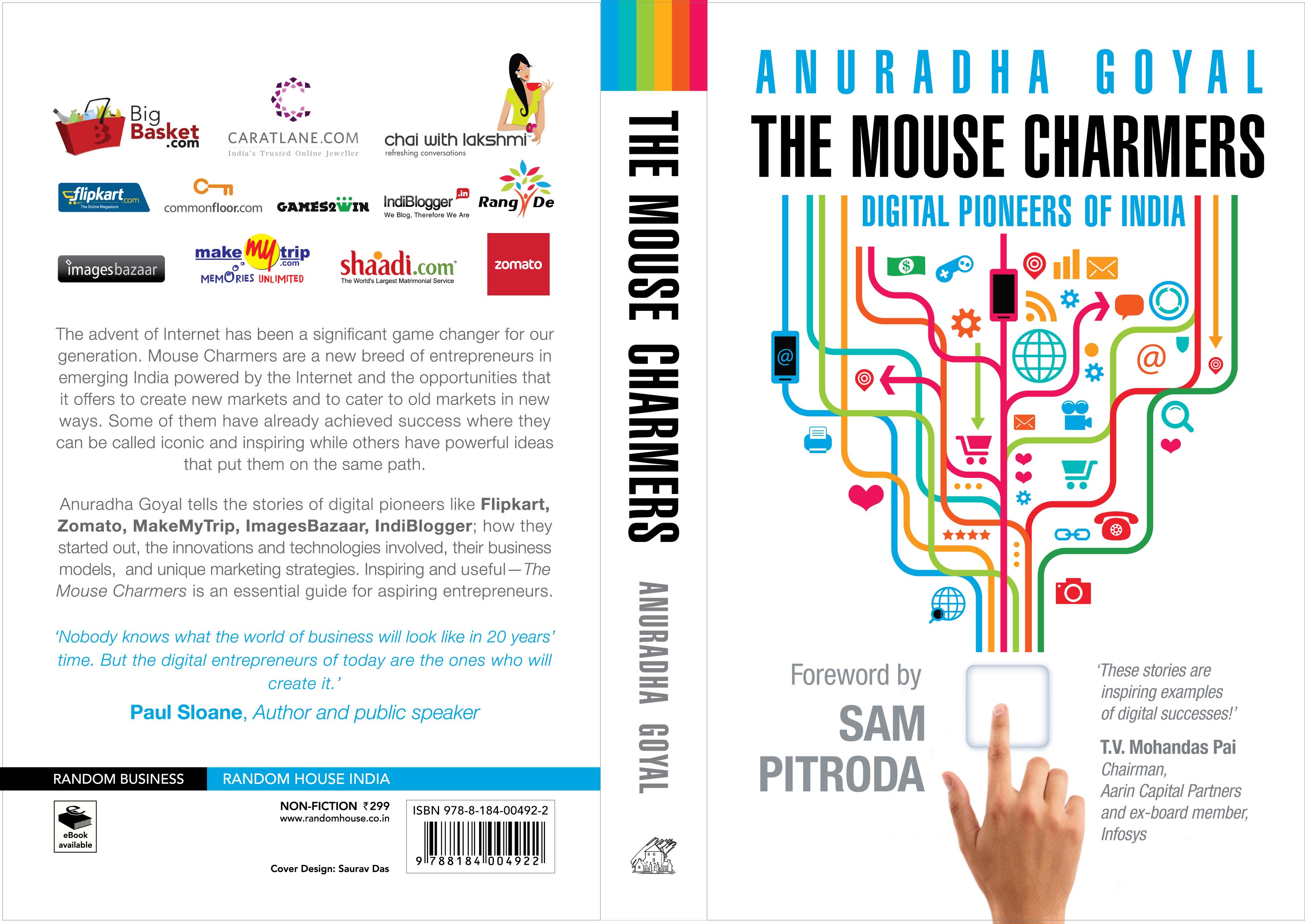
Mouse charmers by Anuradha Goyal: A book review


If you live in India, chances are high you are familiar with companies like Flipkart, Makemytrip.com, shaadi.com. Like me, you might have bought books from flipkart and booked tickets from Makemytrip. You might have paid using cash-on-delivery. And that may give you a feeling, “Oh, I know how this business works”. But, do you really know how these businesses really work? Anuradha Goyal points out in her debut book “The mouse charmers: Digital pioneers of India” – The devil lies in the details. Do you know how Flipkart uses A/B testing framework to perform dozens of experiments at a time? How Zomato manages to keep its menu updated? On an average, how much does it cost Games2win to develop a new online game? Anuradha brings out such details and much more through the stories of 12 digital pioneers of India. Here are 3 things that I liked about Anuradha’s book: (Note: Anu is a friend of mine and hence this review will carry a natural bias).

Broad canvass: Amazon, Google and Yahoo are all Internet players. However, they are fundamentally different businesses. Amazon is an e-commerce player, Google is primarily a connector and Yahoo a content provider. Anu uses this categorization (commerce, content and connectors) to cover a broad canvass of Internet players from India in this book. Apart from the big daddies like flipkart, it also has smaller players like ImagesBazaar, Games2win, Chai with Lakshmi. It covers commodity players like BigBasket (online grocery) and it also has luxury players like CaratLane. Two sectors which are conspicuously missing are healthcare and education. Reason is obvious – these are still in a nascent form. If we go by the buzz around where Venture Capitalists (VCs) are investing today, picture is likely to be different a few years from now.

Business model emphasis: The part of the book which I found most interesting is Anu’s abstraction of the business model for each player and emphasizing the components that are most crucial in that business. A content player like Zomato has a very different business model than a Flipkart or Makemytrip. For example, for Zomato, keeping the menu card updated is most important. It means visiting its 1,00,000 restaurants every 90 days. That’s a significant investment! For BigBasket.com which delivers perishable items within hours of order, logistics management is one of the most crucial elements. Given the chaos on the roads of the Indian metros, how do you do it? Currently, BigBasket delivers in 4 slots during the day, 2 in the morning and 2 in the evening. Anu highlights various business model templates like Freemium, Media model (Zomato), SNAP (Studio, Network, Application and Portal – Games2win) used by the players.

What are they doing differently? Each player is trying to do various things to differentiate itself. Flipkart is using analytics in presenting live statistics, identifying sudden spikes in orders and taking policy decisions such as the minimum purchase price for free shipping. For Makemytrip it is the route planner, CaratLane’s emphasis on educating customer on how to judge a diamond etc. For many players technology platform is a differentiator and some cases Anu’s goes into more details to present the broad architecture of the platforms.

Here are two perspectives I feel the book could have done better on:

Financial perspective: For any budding entrepreneur, it is important to know how much investment is needed, how did these guys source the capital, how much did they put from their pocket, how long did it take to become profitable, how much is the typical margin etc. An important dimension is to provide VC perspective – Who all are the players who invested in these companies? At what point of time in their journey? How much? Etc. Not much is available in the stories.

Failed experiments: What did work is indeed useful. However, what didn’t work is equally if not more useful. Unfortunately, such information is not easily available especially in Indian context. Anu has tried to present this data wherever she was able to get it. In fact, Games2win has explicitly listed failed experiments in its website. However, not much of this is present.

Overall, Mouse Charmers presents an excellent overview of the digital landscape of India. I am sure budding entrepreneurs will find this book useful. The scene is changing fast but business models are re-usable. I admire Anu for wearing multiple hats at the same time – travel blogger, book reviewer, innovation consultant. With this book she adds another feather in her cap. I wish the book success.