Monday, February 28, 2022

Can tradition cause brain damage?


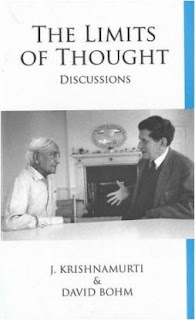
“Tradition is a form of brain damage” – is what physicist David Bohm and spiritual teacher Jiddu Krishnamurti agree upon in one of their dialogues in the book “The limits of thought”1. A few months ago I got an opportunity to facilitate a reading-and-reflection session on this dialogue and this sentence created discomfort among a few of the participants. They had valid points. Neither Bohm nor Krishnamurti was a neuroscientist. On what basis are they making such a claim? And neuroscience has advanced significantly in the last fifty years since they had this dialogue. Does it support it now? Let’s explore it in this article.

Let’s begin with the dialogue and then look at it through a neuroscience lens. Here is an excerpt from the dialogue:

DB: It occurred to me that tradition is a form of brain damage.

JK: I agree.

DB: Any tradition, good or bad, makes people accept a certain structure of reality, very subtly, without their realizing they are doing it, by imitation, or by example, or by words, just by statements. So very steadily the child builds up an approach in which the brain attributes things which are in the tradition to a reality which is independent of tradition. And it gives it tremendous importance. Tradition has real effects of all sorts, which may even be valuable in some ways. But at the same time it conditions the brain to a reality, which is fixed.

A person may look at that reality and say, “That’s reality, I‘ve got to keep my feet on the ground.” But this ground has been created by tradition, by thought; it is no ground, it has nothing under it at all. It is sustained and nourished by this damaged brain, which is unable to get out of that circle.

Now, let’s turn to a current neuroscience perspective.

Typically, we associate brain damage with some kind of lesion, some physical damage to the structure of the brain. However, that is a limited view of brain damage. According to Karl Friston, a leading neuroscientist, there are two kinds of brain damages2. One is anatomical and the other is functional. He uses radio as a metaphor to illustrate the difference. Anatomical damage is like cutting off the wires in radio, while functional damage is equivalent to transistors becoming dysfunctional. A transistor is dysfunctional when the message passing through the wires gets broken. In neurobiology, such a failure is called neuromodulatory failure when the messages passed through neural synapses are not gated and/or weighted properly. This results in loss of gain control meaning loss of control in excitation and inhibition of various signals.

As Friston articulates, when the gain control is broken, it results in strengthening false beliefs because the inferences based on the sensory information get compromised. For example, should I carry an umbrella today? This question would be answered based on the weather forecast and the likelihood of rain. When beliefs become rigid, the information passing mechanism becomes dysfunctional and incoming information related to rain is either suppressed or considered unreliable similar to a transistor malfunctioning. So I may end up carrying an umbrella no matter what.

Perhaps what Bohm-Krishnamurti are suggesting is that tradition has the capacity to make certain beliefs so strong that they are no longer amenable for update based on contextual information such as weather forecast. Beliefs related to what dress to wear or not wear, what to eat or not eat, what rituals to carry out, whom to marry or not marry may become so rigid that they suppress the passage of contextual information.  They are treated as true and fixed no matter what. As far as certain beliefs are concerned, the brain becomes dysfunctional, fixed, and context-insensitive.

Thus tradition may cause functional brain damage. What Bohm-Krishnamurti say in the dialogue is that the damage may or may not be permanent. What could heal such damage? Krishnamurti suggests that perception or insight into the whole belief structure, its rigidities and how it is operating, in the form of thought, being stuck in a grove, may heal the brain. I am not aware of any scientific research supporting such a claim. However, work such as that of Catherine Kerr, supports a milder form of this claim. That is, a practice of shifting attention away from thinking into body sensations and breathing may result in making the neuromodulation mechanism more flexible. That is, it may improve the quality of information flow through the neural pathways.

Source:

1.      “The limits of thought”, J. Krishnamurti and David Bohm, Krishnamurti Foundation India, 2013, chapter 5 “Tradition and truth”, page 84. This dialogue happened on August 6, 1975, in Gstaad, Switzerland.  Bohm suggests that “Tradition is a form of brain damage” at 6:13 in the audio

2.      Dysconnection hypothesis of schizophrenia”, August 10, 2017, In this video Karl Friston explains the nature of mental disorders and the possibility of a therapeutic cure of schizophrenia.


Friday, February 25, 2022

Neuroscience of mindfulness: My 4 takeaways from Catherine Kerr perspective

Catherine Kerr (1964-2016) was an American neuroscientist who made important contributions to the neuroscience of mindfulness. Her research was focused on the relationship between the material processes in the brain and the body awareness practices like mindfulness, tai chi and qigong. I found her work interesting because of three reasons. One, she had a cautious attitude towards the tall claims attributed to mindfulness. “Don’t believe the hype,” she said while also mentioning, “Behind the hype, there is some truth”. Two, I found her work on brain rhythms especially alpha waves and their relationship to mindfulness intriguing and relatable. And, three, she was trying to balance quantitative research from brain imaging studies with qualitative research from personal diaries and narratives. In this article, I would like to present my 4 takeaways from Cathy’s perspective. They are related to attentional freedom, brain rhythms, body-brain information loop, and existential reorientation.

Regaining attentional freedom: For many of us, attention is primarily consumed by repetitive thought patterns. Cathy calls this state of mind ungrounded. “Some people don’t even know that they can shift their attention in their body,” she says1. Mindfulness begins with learning to shift attention out of thinking into body sensations. This is what Cathy calls learning to regain attentional freedom2. “When mind lands in the body, you really feel it”3. This is the first step for many of us who tend to be dis-embodied. Cathy feels that people with chronic pain don’t have attentional freedom4.

When attention shifts from ruminating thoughts like “I am not good enough” to present moment sensations there is a different circuit in the brain that gets activated5. Anxious rumination activates the medial prefrontal cortex, also called the default mode network. And present moment awareness activates the lateral prefrontal cortex. Activation of these two circuits is found to be anti-correlated.

Alpha waves as volume control knobs: “How does a practice that begins by paying close attention to the toe reduce negative thoughts?” This is how Cathy introduces the research question she explored6. Her subjects, the treatment group, underwent the 8-week Mindfulness-Based Stress Reduction (MBSR) program. Her findings suggested that the thalamus and associated circuits act as a gatekeeper for various signals and alpha rhythms, brain waves of frequency around 10Hz, act as volume control knobs. For example, currently, as I am sitting in front of a laptop, there is sensory information coming in from my butt on the chair, visual input from the laptop screen, auditory input from surrounding sounds, thoughts related to this blog, etc. Alpha rhythms regulate these signals and block the signals it considers non-relevant in the current context.

When we become dis-embodied and attention is taken up mostly by thoughts, alpha rhythms become inflexible and tend to suppress bodily signals. What Cathy found out is that after 8-weeks of BMSR practice which involved paying attention to bodily sensations, alpha rhythms became more flexible in a statistically significant way. This flexibility extends to other signals as well. That is, learning to be mindful of the body teaches you to be mindful of the other sensations, thoughts and feelings7. Her research also found out that people with chronic pain have inflexible alpha rhythms and they lose access to body-space.

Cathy also mentions that meditators sometimes report feeling cortical rhythms and palpable sensations in other body areas. For me, feeling some kind of tingling sensation in the head, and in other body areas but especially in the head is common. Could that be alpha rhythms? Who knows?

Body-brain information loop: When we hold a cup or an egg in hand, the brain sends motor commands to the hand that moves the muscles. When the egg is held sufficiently tightly, the hand sends information back to the brain telling, “No more motor commands, I have taken in enough of information.” Thus, there is a circular information flow from brain to body and vice versa. This information flow from hand to the brain can be measured by looking at the beta rhythms which are stopping rhythms. Traditionally, scientists have studied these rhythms to understand what is flowing from brain to body. But Cathy’s research looked at the information flow from muscle spindle neurons back to the brain8

Her hypothesis was that when we are more embodied i.e. our awareness extends into our body, the quality of information sent back from the body to the brain is better. Apart from beta rhythms, Cathy also looked at clinical markers in fatigue called inflammatory cytokines9. For this research, Cathy decided to focus on distressed cancer survivors because many of them tend to be actively fatigued for years. They don’t have the energy to do exercise. However, they may be able to do slow body awareness exercises like tai chi and qigong. Cathy was a cancer survivor herself for two decades and a practitioner of these Chinese practices.

Cathy felt that mindfulness needs to be taken “off the cushion”10. Mindfulness is not only about doing a seated meditation. It can happen while you are moving. “Mindfulness on the go” has been an important aspect of my workshops and hence this aspect is interesting to me.

Existential reorientation: During her brain imaging research with the 8-week mindfulness program practitioners, Cathy also looked at the daily journal of some of the participants. And, she was surprised to find that most of them went through a lot of distress during weeks 4, 5 and 611. Participants experienced a feeling of insecurity. Some felt like quitting and moving to the Bahamas. Some of them felt like quitting the program. And in weeks 6, 7, and 8 participants began to settle into a positive trajectory. This led to a new hypothesis that perhaps somatic awareness in the longer-term leads to an existential reorientation i.e., re-construction of self-image12. Self-image has multiple dimensions e.g., bodily self, volitional self, narrative self, social self, etc. Self-image change includes changes to the body’s representation in the brain. She mentioned that this is just a hypothesis and yet to be tested.

From my personal experience and through the interaction with others, it is not at all uncommon to see existential reorientation. Am I an independent entity trying to be in control of the situation? Or am I deeply connected with the world with an illusion of control? Questions of these sorts are common in mindfulness exploration. Are there any associated mechanistic changes to the cognitive processes when the existential orientation changes? It will be interesting to see.

As you can see, many of the questions that Cathy asked haven’t been answered conclusively. However, I liked the questions themselves and I am sure they will have a life of their own.

Sources:

1.       Episode 56: Embodied cognition and its effects on health with Cathy Kerr”, a podcast interview by Brook Thomas, May 31, 2016 (time stamp: 13:40)

2.       Starting with the body: the neuroscience of somatosensory attention”, a talk by Catherine Kerr at Amherst College, Nov 11-13, 2011 (Cathy talks about attentional freedom at 28:53)

3.       Episode 56” (14:35)

4.       Starting with the body” (28:58)

5.       Starting with the body” (6:20)

6.       Mindfulness starts with the body: A view from the brain”, TEDx talk by Catherine Kerr, May 22, 2012 (3:00)

7.       Starting with the body” (16:40)

8.       Episode 56” (Cathy talks about beta rhythms and the information flow at 43:55)

9.       Episode 56” (Cathy talks about the clinical markers of fatigue in blood at 27:00)

10.   Episode 56” (17:50)

11.   Using qualitative methods in mindfulness studies to contextualize brain data”, talk by Catherine Kerr at UC Davis, May 21, 2015. (18:30)

12.   Using qualitative methods in mindfulness” (20:20)

Wednesday, February 9, 2022

Innovation dashboard: examples of process goals

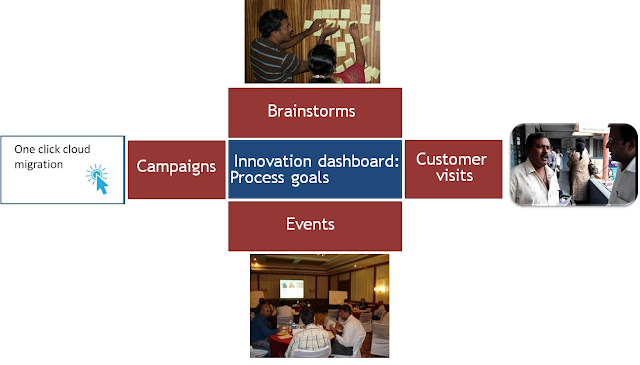
In an earlier blog, I have proposed that an innovation dashboard is the defining characteristic of a basic form (level-2) of innovation maturity. Most innovation dashboards have a bias for outcome goals – ideas, patents, experiments, participation, savings, revenue, profit, etc. However, those who exercise would know the importance of process goals. For an outcome goal such as weight reduction, it helps to have a process goal such as 10,000 steps a day. What could be the process goals in an innovation dashboard? Here are a few suggestions bucketed under four categories: brainstorms, customer visits, events, and campaigns.

1.     Brainstorms: These are meetings where divergent thinking is encouraged. Types of meetings could be:

a.     Challenge book brainstorm: where challenges relevant to a business, function or customer engagement are brought out / prioritized. The team may decide to take a position on one or two key challenges.

b.     Solution brainstorms: Ideas in response to a challenge are explored together

c.      Journey mapping: Observations from the journey of a product/ service/ issue/ ticket are mapped onto a journey board from which patterns/insights could be derived. 

2.     Customer visits: These could be meetings at customer premises or in the field but these also could be focus group discussions where customers are brought together on vendor’s premises.

a.     Field-visit: The objective here could be to interview customers / potential customers. The intent could also be to validate prototypes.

b.     Focus-group discussion: A toy-maker may bring kids while a medical device maker may bring doctors for a focussed group discussion.

c.      Co-innovation workshops: These are workshops where various stakeholders associated with a challenge area are brought under one roof. For example, for a challenge related to education, one may bring students from different schools, teachers, parents or even dropouts if relevant to understand various perspectives. 

3.     Events: could last half day to 2-3 days. Here are a few possibilities:

a.     Innovation review: This could be a half-day event where all innovation projects get reviewed and resource allocation happens.

b.     Hackathon: This 1 or 2-day event might bring people with ideas related to a challenge area under one roof where they build prototypes and bring their ideas alive.

c.      Training: These programs could be a few days to a few weeks long. As part of these training programs, participants may work on business-relevant challenges, create solutions, build prototypes and even present business cases to a panel.  

d.     Innovation day: This day-long event typically showcases innovations from teams within the organization, gets external speakers, and gets people to talk to each other. 

4.     Campaigns: This is arguably the trickiest category. It involves running a campaign around a challenge perhaps over a month or two. It combines some of the elements mentioned earlier. It begins by identifying a sponsor – a CXO or a business head – who is willing to sponsor promising ideas solving business-relevant problems. Some of the steps involved in a challenge campaign area: finding a sponsor, throwing open a challenge, inviting and selecting ideas, organizing a hackathon for selected ideas, mentoring promising teams to develop the ideas further and making a business case and finally presentations to a panel which selects one or more ideas to carry forward.

Hope these examples help in identifying a few process goals for your innovation dashboard.

Sunday, December 26, 2021

Ramana Maharshi’s self-inquiry through Upadesa Saram verses

I have been reading Ramana Maharshi (RM) for the past twenty-five years. However, Upadesa Saram (The essence of the teaching) is special because it is the only text which I am able to read currently in the same language that Ramana Maharshi wrote in – Sanskrit. It was originally composed in Tamil (1927) and RM himself translated it in three other languages – Telugu, Malayalam, and Sanskrit. Ramana Maharshi championed the self-inquiry approach and suggested that “Who am I?” is the most important question in spirituality (and perhaps life itself). Upadesa Saram has 30 verses. In this article, I have selected four that highlight the self-inquiry approach. For each verse, we will see it in the Devanagari script and English, followed by my English translation (hence, all errors are mine). Then I have given some text sourced from “Talks with Ramana Maharshi” which I feel is relevant to the verse. Finally, I have added my comments to each verse based on my limited understanding. There is a beautiful rendering of Upadesa Saram on YouTube (verse 16 starts at 2:50).

Verse 16:

दृश्यवारितं  चित्तमात्मनः   

चित्त्वदर्शनं तत्त्वदर्शनं ॥16॥

drsya-vaaritam cittam-aatmanah

cittva-darshanam tattva-darshanam

Translation: By turning attention away from external objects towards the mind, the Self is seen, the essence is seen.

RM comments: “Because your outlook has been outward bent, it has lost sight of the Self and your vision is external. The Self is not found in the external objects. Turn your look within and plunge down; you will be the Self”. (talk 238)  “The Self is giving rise to the mind, sustaining it, and resolving it. So the Self is the underlying principle.” (talk 97)

My comments: In self-inquiry, turning the attention inward to watch the mind and associated movements, is arguably the most important and perhaps the most difficult step. For most of us, the story of self (the limited-I) is extremely important and attention-grabbing.

Verse 17:

मानसं तु किं मार्गणे कृते        

नैव मानसं मार्ग आर्जवात् ॥17||

Maanasam tu kim maargaNe krte

Naiva maanasam maarga arjavaat

My translation: When explored, “What is mind?” (One finds) there is no mind; that is the most direct path.

RM comments: “Continuous search for what the mind is results in its disappearance. This is the straight path” (talk 222).

My comments: What does RM mean when he says, “There is no mind”? It is a state in which the mind, the body, and the world are seen to be not separate from the Self. “They (the body, the mind, and the world) do not remain apart from the Self.” (talk 97) So, "there is no mind" means, there is no separate mind like a wave is not separate from the ocean.

Verse 18:

वृत्तयस्त्वहं वृत्तिमाश्रिताः       

वृत्तयो मनो विध्द्यहं मनः ॥18||

Vrttayastvaham vrttimaashritaah

Vrttayo mano viddhyaham manah

My translation: The self (limited-I) is a bundle of thoughts. These thoughts spring from I-thought as the source.

RM comments: “The sense of body is a thought; the thought is of the mind, the mind rises after the ‘I-thought’, the ‘I-thought’ is the root thought.” (talk 244)

My comments: Here “thought” means both thoughts that are currently active as well as latent predispositions. RM says, “The mind may be latent and it must necessarily rise up again; after it rises up one finds oneself only as ever before. For in this state the mental predispositions are present there in the latent form to remanifest under favourable conditions.” (talk 465)

Is this I-thought a subject or an object? RM says, “Inasmuch as it witnesses all other objects in the waking and dream states, or at any rate we think that it does so, it must be considered to be the subject. On realising the Pure Self, however, it will be an object only.” (talk 323) I feel watching the nature of I-am-the-body disposition spring up and subside just like how other sensations and emotions arise and pass away is an important aspect of self-inquiry.

Verse 19:

अहमयं कुतो भवति चिन्वतः       

अयि पतत्यहं निजविचारणम् ॥19||

Ahamayam kuto bhavati cinvatah

Ayi patatyaham nijavicaranam

Translation: When reflected, “Where does this I-thought come from?” this I-thought vanishes. This is self-inquiry.

RM-comments: “The ego is itself unreal. What is the ego? Enquire. The body is insentient and cannot say ‘I’. The Self is pure consciousness and non-dual. It cannot say ‘I’. No one says, ‘I’ in sleep. What is the ego then? It is something intermediate between the inert body and the Self. It has no locus standi. If sought for it vanishes like a ghost. You see, a man imagines that there is something by his side in darkness; it may be some dark object. If he looks closely the ghost is not to be seen, but some dark object which he could identify as a tree or a post, etc. If he does not look closely the ghost strikes terror in the person. All that is required is only to look closely and the ghost vanishes. The ghost was never there. So also with the ego. It is an intangible link between the body and Pure Consciousness. It is not real. So long as one does not look closely it continues to give trouble. But when one looks for it, it is found not to exist.” (talk 612)

For the limited-I, a typical question is, “How do I know if there is spiritual progress?” RM answers, “The degree of absence of thoughts is the measure of your progress towards Self-realisation. But Self-realisation itself does not admit of progress; it is ever the same. The Self remains always in realisation. The obstacles are thoughts. Progress is measured by the degree of removal of obstacles to understanding that the Self is always realised. So thoughts must be checked by seeking to whom they arise. So you go to their source, where they do not arise.”

My comments: Instead of judging whether the I-thought has vanished, I feel it is important to seek the source of thoughts as RM suggests in the first line of this verse. This requires learning to watch the movement of thought while thinking. If this feels too difficult, it may help to learn to watch the movement of breath and/or body sensations which are subtler than the body movement but not as subtle as the movement of thought.

Interestingly, the Sanskrit word “nija” in “nija-vicaranam” (last words of the verse) means both self and constant or continual. Hence, “nija-vicaranam” can also be interpreted as constant-inquiry in addition to self-inquiry.  As RM says, “The sadhak (seeker) must remain as the Self. If he cannot do so, he must ascertain the true meaning of the ‘I’ and constantly revert to it whenever other thoughts arise. That is the practice.” (talk 647)

Sources:

  1. “Sri Ramana Maharshi’s way: A translation and commentary on Upadesa Saram”,  D. M. Sastri, Sri Ramanasramam, 1999.
  2. Upadesa Undiyar of Bhagavan Sri Ramana”, word for word translation by Sadhu Om and Michael James of the original Tamil version, 1980.
  3. Talks with Sri Ramana Maharshi”, Sri Ramanasramam, 2006.
  4. A Sanskrit dictionary
  5. Image source: wikipedia.org

Friday, December 24, 2021

David Bohm’s matter-energy-meaning equivalence proposal through six examples


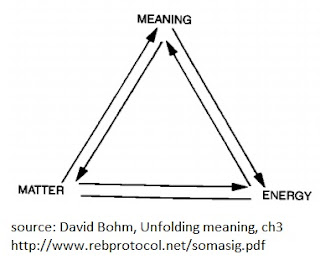
Mind-matter duality vs non-duality has been debated by philosophers and mystics since antiquity. However, scientists entered the discourse only recently. Hundred and fifteen years ago (1905) Einstein proposed matter-energy equivalence in a rigorous manner. It took thirty years to verify it experimentally. A few years ago I came across an extension of this equivalence that includes meaning along with matter and energy in a book “Unfolding meaning” (1985) which is an edited transcript of a weekend dialogue with David Bohm in 1984 in England (See the above figure). Bohm’s proposal of matter-energy-meaning equivalence was not a rigorous scientific presentation. However, it used scientific results as metaphors to explain it in an intuitive way. In his proposal, Bohm also puts meaning as more fundamental than matter and energy. A few years later (1990) John Wheeler, a towering figure in theoretical physics, proposed “It from bit” i.e. “All things physical are information-theoretic in origin”. Since then, over the past thirty years, this paradigm i.e. everything is meaning (or its close cousin - information) has gained momentum among the scientific community (e.g. check out Robert Kuhn episode "Does information create cosmos?"). In this article, I would like to briefly present Bohm’s proposal in his own words through six examples from his article “Meaning and information” (1989). And in the future, I hope to look at how others have explored this paradigm.

----Bohm’s words------

Meaning is the essence of reality. Meaning is inexhaustible. There is no limit to meaning. There is no fixed meaning. All meaning is ambiguous; it depends on the context, as the context changes so does the meaning.

Meaning is the activity of information. Any form to which meaning can be attributed may constitute information. This is generally potentially active, and may become actually active when and where there is a receiver which can respond to it with its ‘own energy’.

Six examples:

(1)    The form is held in silicon chips, which have very little energy, but this form enters into the much greater energy of overall activities of the computer and may even act outside the computer e.g. in a ship or an airplane controlled by an automatic pilot guided by the information in radar waves.

(2)    DNA molecule constitutes a code and the RNA molecules ‘read’ the code and are thus ‘informed’ as to what kind of proteins they are to make. The form of DNA molecule thus enters into the general energy and activity of cell. At any given moment, most of the form is inactive, as only certain parts of it are being ‘read’ by the RNA, according to the stage of growth and circumstances of the cell.

(3)    When the form of a road sign is apprehended in the brain and nervous system, the form is immediately active as meaning e.g. if the traffic sign says ‘stop’, the human being brings the car to a halt.

(4)    A more striking example is that of a person who encounters a shadow on a dark night. If this person’s previous experience is such as to suggest that there may be assailants in the neighbourhood, the meaning of an assailant may be immediately attributed to this form. The result will be an extensive and powerful activity of mind and body, including the production of adrenaline, the tensing of muscles, and an increase in the rate of the heart. But if on closer inspection, this person sees further evidence indicating that it is only a shadow, all this activity stops, and the body and mind becomes quiet again.

(5)    According to the quantum theory, a single particle such as an electron shows wave properties as well as particle-like properties. Hence, a particle must be understood in terms of both the particle and the wave field which always accompanies the particle. This Schrodinger wave does not act like, for example, a water wave on a floating object to push the particle mechanically with a force proportional to its intensity. Rather, a better analogy would be that of a ship or aeroplane on automatic pilot guided by the information in the radar waves. Similar to radar waves, the waves associated with a particle contain active information.

(6)    For a collection of particles, there is a common pool of active information. This can be most clearly seen in the superconducting state of electrons in a metal. This is state that may arise at very low temperatures, in which an electric current flow indefinitely without friction. In this state, the common part of information induces an organized and coordinated movement of electrons resembling a ballet dance, in which the particles go around irregularities and obstacles without being scattered.

As the temperate is raised, however, the state of the system changes in such a way that the property of superconductivity disappears. The explanation for this is that the Schrodinger wave field begins to break up into independent factors representing separate pools of information that apply to similar subsystems and eventually at high enough temperatures, to the individual particles themselves. It is as if, in the ballet, the dancers begin to break up into separate groups that are guided by different ‘scores’ until eventually each individual is doing his or her own dance, unrelated to those of others. The coordinated state of movement to disappears, and the electrons behave more like disorganized crowd of people than like an orderly group of ballet dancers.

Meaning for whom? Meaning is for itself. Ultimately there is nobody to whom meaning is “for”. Rather, meaning is the basic quality of reality.

Intelligence is part of the process of perception of meaning. Creativity is related to a constant discovery of new meanings.

---- end of Bohm’s words------ 

There is more to Bohm’s proposal than what is visible in these examples. For example, Bohm talks about how meaning flows from gross level in the matter to subtler levels and vice versa. For more information, please check out the references below.

I hope to explore how others have pursued this paradigm of treating information or meaning as the essence of reality. Your suggestions are welcome.

References:

  1. Unfolding meaning: A weekend dialogue with David Bohm”, David Bohm, Routledge, 1985 (2005 digital edition). Chapter 3
  2. Meaning and information”, David Bohm, from the book, “The search for meaning: The new spirit in science and philosophy”, edited by Paavo Pylkkanen, Crucible, 1989. All the six examples given above are from this article.
  3. A change of meaning is a change of being”, Dialogue between David Bohm and Renee Weber, undated. This is one of my favorite interviews of Bohm.
  4. A new theory of relationship of mind and matter”, David Bohm, Philosophical Psychology, 3:2, 271-286, 1990.
  5. The philosophical and scientific metaphysics of David Bohm,” William Seager, Entropy, 20, 493, 2018. This article looks at Bohm’s metaphysics critically. It points out that Bohm’s “active information” is different from Shannon information commonly used in scientific literature.

Wednesday, December 22, 2021

A response from Mark Jarvis on "Defining characteristics of five levels of innovation maturity"

Mark W. Jarvis is an innovation guru at UNO MINDA Group and Head of International Business Development at INITIA Design Studio. We met at an innovation management session at IIM Bangalore a few years ago. He has been extremely kind to give constructive inputs on my blog "Defining characteristics of five levels of innovation maturity". He has separated the characteristics into two categories - one for innovation managers and practitioners inside the organization and the other for stakeholders and innovation benchmarking outside the organization. Moreover, he has expressed his concerns on some of the metric parameters like the number of patents that bother him and suggested better parameters. Thanks a lot, Mark. Appreciate your input.

----------------------
Hello Vinay,

I very much like your “Defining Characteristics of Five Levels of Innovation Maturity”.

I think it is important for any defining characteristic to be “easily” obtained … and distinguished by availability to the “inside the corporation” innovator or to the “outside the corporation” stakeholder.

Since I am always thinking of how to turn things into charts for PowerPoint slides … here is a chart summarizing your thoughts … with some added 
from me.

Inside Corporation  

(for Innovation Managers and Participants)  

Outside Corporation  

(for Stakeholders and Innovation Benchmarking)  

Level 1  


Ad-hoc   


No Tracking  

Likely an authoritarian workplace riddled with confusion, panic, fear, or lethargy. 😉

No Published Evidence Of Managed Innovation   

(or Evidence Of Sustained Poor Market Performance)  

Level 2  


Foundation  


Innovation Dashboard In Use  


Pipeline, Velocity, and Impact (Process and Outcome) Indicators  

Company-specific Innovation Metrics are gathered and reviewed by management and shared with innovation community.    

Annual Report (R&D spend, Number of R&D centers, Number of patents, Number of new SKUs, Number of new product launches, etc.)  

Level 3  


Engaged  


Rigor and Rhythm of Innovation Review  

Rigorous Innovation reviews (feasibility, desirability, scalability, viability, etc) with consequences (for example, projects de-funded or extra-funded) that are well-communicated.   

Observe who attends, clarity of strategic challenges, innovation champion support, and resource re-allocations.  

?  

Level 4  


Aligned  


Innovation Sandbox   

Innovation Sandbox(es) that is focused by a strategic challenge area, has experimentation capacity, dedicated (politically protected) resources and patient management.  

Press Release or other communications about Innovation Sandbox.    

(Note – it is difficult to gauge the quality of the Sandbox effort from outside the corporation)  

Another type of “Innovation Sandbox’ is a well-managed Outside Innovation effort.  

Level 5  


Excellence  


30%+ Revenue from Innovations in the Last Five Years  

Internal Innovation Dashboard metrics will explicitly include tracking of Revenue from Innovation in the Last Five Years and related long-view systemic innovation metrics.  

Annual Report Revenue Contribution (or Growth Contribution)  


Additional thoughts …

About counting the number of patents … this metric bothers me a bit … as I have seen it misused or misunderstood … but I agree it is a good place to start. As a quantity metric it is easy to measure and communicate. Much better would be a patent strategic quality measure … that tracks the business impact of a patent … or tracks the size of patent space covered … or tracks the quantity/quality of patents that reference your patent. But these quality metrics are not easy to come by … or are easily manipulated. I am optimistic that future innovators will have access to affordable software/analyzers to guide and assess a company’s intellectual property portfolio (including patent mapping (Clarivate’s Innography, etc) and patent valuation (Anaqua’s AQX, etc)). Note – one exception to my thinking on this metric comes to mind … perhaps the USA pharmaceutical industry … which seems to extract huge margins through the sheer quantity (sometimes hundreds) of slightly differentiated patents for a key pharmaceutical product.

About Innovation Sandboxes … It is extremely important that sandboxes be politically protected by patient and enlightened management. Typically, there are corporate jealousy, lack-of-cooperation, and unreasonable payoff time behaviors that distract and destroy Sandboxes. For “outside the corporation” folks … I added Outside Innovation as a “type of Sandbox” … since a company’s Outside Innovation efforts (by definition) are readily observed (Maruti-Suzuki’s MAIL, etc.).

About Level 3 Defining Characteristic To An Insider … In addition to robust Innovation Reviews, innovators will notice that leaders will innovate by walking around ("What new thing did you explore this week?") and have pleasant discussions about smart failure.

About Level 3 Defining Characteristic To An Outsider … I am wondering what this could be … to a company stakeholder (investor, financial journalist, innovation benchmarker, etc.)?

I am happy to know your (and others) additional thoughts.

Mark Jarvis

Sunday, December 19, 2021

2 ways of learning to fail with comfort

Failing can’t be a comfortable event. Or so I believed for a long time. Until I came across a suggestion from Nassim Taleb thirteen years ago (December 2008) which said, “Learn to fail with pride, comfort and pleasure”. My initial reaction was disbelief. And yet I decided to take the suggestion very seriously and kept on testing it as a hypothesis. Over the past decade, I discovered that I don’t experience pride and pleasure when things don’t work out. However, I felt it is possible to be comfortable with failing. And the experimentation involved trying 2 broad approaches: (a) protecting against the downside, and (b) subtracting expectations both of which came from Taleb himself. So here is a short reflection on what these approaches meant for me. But let me begin with the context.

Nassim Taleb’s interview was published in December 2008 issue of McKinsey Quarterly. It was related to Taleb’s book “The black swan: The impact of the highly improbable” which got published in 2007 and became a big hit especially during the financial crisis of 2008. In this interview he was asked, “What would your ideas look like in practice for, say a manufacturer?” And Taleb said, “If risk doesn’t cost you a lot, take all the risk you can. Do more trial and error. Learn to fail with pride, comfort and pleasure.” And then he added, “But try to have less downside exposure by building more slack into your system through redundancy, more insurance, more cash, and less leverage. Imagine a shock. What will happen if there’s a shock? How many months could you keep operating?”  

When I read Taleb’s interview in December 2008, I was self-employed for a little over two years. My consulting pipeline was dry and with the impending downturn there was failure written all over. I was uncomfortable and anxious, far away from being proud and pleasurable. We had moved into a new apartment and there was a burden of housing loan. And hence, I was both sceptical and curious about “learning to fail with pride, comfort and pleasure”. It didn’t take me much time to drop the “pride and pleasure” part as unnecessary and stick to just “learn to fail with comfort”. Here is what it meant for me to experiment with the two approaches:

Protect against downside: Over the next few years, I did following:

  • Paid off the housing loan and increased the cash position. I was lucky to have some stocks from my previous employer that helped in this process.
  • Wore helmet while cycling and seat-belt while driving 😀
  • Took data backups seriously and it became a ritual. Laptop crashed a few times but never became a big issue.
  • Took protecting customer’s confidential information very seriously. Similarly, while building on others’ ideas, I made sure I attribute credit to the source of ideas. Learned to make modest claims about what management of innovation can achieve in an uncertain world.
  • Took low-cost experimentation very seriously. This meant offering different open workshops in hotels and testing which ones are more attractive to customers. Many of them didn’t last and it didn’t hurt at all. Started presenting my ideas through blogs which was and is free and I find it to be a good platform for early testing of ideas.

Subtract expectations: No matter how much one tries to protect oneself, with helmet, cash, insurance or a vaccine, an accident or a virus can spring unexpected surprises. And the setback could feel like a failure. This is where we turn to the question: Why expect at all that life will be smooth? In fact, can one routinely anticipate disruptions?

Seneca, a first century Stoic, is one of Taleb’s heroes in the book “Antifragile: Things that gain from disorder”. Seneca used to mentally write-off all his possessions before going to bed as if he were to be in a shipwreck. If he still had them when he woke up, it was a bonus.  Seneca was a shipwreck survivor and perhaps he had experienced the fragility of life first-hand. Taleb quotes Seneca, “He is in debt, whether he borrowed from another person or from fortune.”

Thus expectations or desires are also a kind of debt which turns into obligations to be fulfilled. When not fulfilled it feels like a failure. “Oh, I couldn’t buy the car I wanted so badly.” But subtracting expectation debt is not as easy as paying off monetary debt. Expectations can be deep-rooted and subtle. We can’t just subtract the waves on the ocean, can we? So this is what I learned from spiritual teachers like Jiddu Krishnamurti, David Bohm and Eckhart Tolle that I could apply it my context.

An expectation gets subtracted when it is seen as meaningless. And to see expectations in action one needs to learn to watch the movement of thought while thinking. This movement is subtler than the movement of breath. Moreover, expectation per se is not bad. It is the force behind the expectation turning it into an absolute necessity that makes failing dreadful. Over the years, watching the movement of thought has become a second nature for me. However, thought is a sophisticated process and it is extremely good at creating self-deception. So watching the movement of thought is a lifelong learning process.

Does it mean I have no expectations? No. I do make plans – some short term (course teaching plan) and some long-term (consulting focus for the next few years). Earning a livelihood is still important. However, if things don’t go as per the plan, and they invariably do, it doesn’t surprise me. In fact, I anticipate and watch out for surprising signals, both positive and negative and course correct if necessary. And failing has felt normal and comfortable for the past several years.

To summarize, protecting against downside exposure and subtracting expectations are two ways of learning to fail with comfort. Subtracting expectations needs alertness to watch the movement of thought and recognize the meaninglessness of expectations when they don’t make sense anymore.