Showing posts with label mindfulness book. Show all posts

Sunday, July 20, 2025

My key takeaways from Ronald Purser’s McMindfulness

Ronald Purser feels that the current mindfulness fad is the entrepreneurial equivalent of McDonald’s. Spiritual salesmen are commoditizing mindfulness and making money by marketing it as a more efficient, calculable, predictable, and controlled form of meditation for improving mental fitness. “One invests in mindfulness as one would invest in a stock hoping to receive a handsome dividend,” says Purser in the book “McMindfulness: How mindfulness became thenew capitalist spirituality”. As a mindfulness teacher and author of a book on the subject, I was attracted to the book to understand Purser’s criticism as well as to check how my teaching stands against Purser polemic. In this article, I will summarize the key points from the book and in a subsequent article, I will write my response to Purser’s critique as well as assessment of journey-led mindfulness that I teach against the critique.

Which mindfulness? Before we look at Purser’s criticism, let’s understand what is the form of mindfulness Purser is putting under the scanner. It includes Mindfulness Based Stress Reduction (MBSR) an 8-week therapeutic intervention championed by Jon Kabat-Zinn initially in a clinical setting and subsequently expanded to corporations, schools, government, and the military. Purser also looks at corporate mindfulness programs such as Google’s “Search Inside Yourself” which was subsequently spun off as a leadership institute.

The mindfulness under review here is “nothing more than basic concentration training. Although derived from Buddhism, it’s been stripped of the teachings on ethics that accompanied it, as well as the liberating aim of dissolving attachment to a false sense of self while enacting compassion for all other beings.” It involves paying attention to the present moment, non-judgmentally. And, shifting from “doing” mode to “being” mode.

Now, let’s look at Purser’s key arguments.

Crisis is in the head: Purser feels that giant corporations like Google, Facebook, Twitter, and Apple are monetizing and manipulating our attention. Rather than looking at this aspect, mindfulness champions are telling people to go inward, be in the present moment and let go of judgments. He says, “Mindfulness has, like positive psychology, and the broader happiness industry, depoliticized and privatized stress. If we are unhappy about being unemployed, losing our health insurance, and seeing our children incur massive debt through college loan, it is our responsibility to learn to be more mindful.” “We are repeatedly sold the same message that individual action is the only real way to solve social problems, so we should take responsibility.” Purser feels this approach stifles critical and radical thinking.

Tool for self-improvement: We are told that if we practice mindfulness and get our individual lives in order, we can be happy and secure. Google’s “Search Inside Yourself” program champion Meng promises, “Mindfulness can increase my happiness without changing anything else.” Jon Kabat-Zinn is quoted in the book saying, “Mindfulness may actually be the only promise the species and the planet have for making it through the next couple of hundred years.” David Gelles, author of Mindful work, says in his book, “Mindfulness can be a source of employer value proposition and may in the long run provide organizations with a valuable tool to manage high burnout levels of employees.”

What’s wrong if all this could actually happen? Purser points out that the scientific evidence for these improvements is poor. Thupten Jinpa, The Dalai Lama’s interpreter and a PhD from the University of Cambridge says, “The scientific study of meditation and its effects is very rudimentary.”  Another scientist is quoted saying that there is convincing evidence that mindfulness studies suffer from positive reporting bias, suggesting therapies are more effective than they really are. “Mind the hype” an article authored by fifteen researchers says, “As mindfulness has increasingly pervaded every aspect of contemporary society, so have misunderstandings about what it is, whom it helps, and how it affects the mind and brain. At a practical level, the misinformation and propagation of poor research methodology can potentially lead to people being harmed, cheated, disappointed, and/or disaffected.”

Secular approach without ethics or wisdom: While the secular mindfulness programs have their roots in Vipassana tradition, Purser feels that the ethics and wisdom part of Buddhism has been kept out. He says, “The claim that major ethical changes intrinsically follow from ‘paying attention to the present moment, non-judgmentally’ is patently flawed.” In Buddhist tradition, right mindfulness is one of Buddha’s eightfold path along with right perception, intention, speech, action, livelihood, effort, and concentration. Purser points out that secular mindfulness programs leave other seven things out. Buddhism also points to the constructed self or the insight of interdependence or pratitya-samutpada. To see that the feeling of independent self is a cognitive illusion is an important aspect of Buddhist teaching. Many mindfulness programs, especially in the clinical settings, leave this part out. If mindfulness helps you to connect with the real you, then what do you do after that? If you simply bliss out and accept injustice, how is it different from being a drug addict, sedated into zombified oblivion? Purser asks.

Purser’s suggestions: He feels that a truly revolutionary mindfulness would challenge the western sense of entitlement to happiness irrespective of ethical conduct. He feels mindfulness should aim towards individual and collective “conscience explosion,” converting exhaustion, depression, and burnout into constructive forms of activism. It should move towards personal, social, and ecological liberation. It should combine spiritual practice with radical action. By first witnessing shared vulnerabilities and acknowledging social suffering it should develop collective capacities for resistance by building trust and empathy.

Tuesday, September 5, 2023

Tracing mindfulness word to its Pali/Sanskrit counterparts: Sati and Vipassanā

In my workshops on mindfulness, it is common to get the question, “How is the mindfulness you teach related to Buddhist practices?” So far, my answer has been, “Both involve learning to see clearly”. I know this is a handwavy answer so I decided to explore the question by looking at its counterparts in Buddhist texts to get a better understanding. In this article, I take two Pali/Sanskrit words which are translated as mindfulness, namely Sati (Smriti) and Vipassana (Vipaśyanā), and look at their meanings. But before we get to these source words, let us place the current usage of mindfulness in a broader context.

The word mindfulness means different things to different people, just like innovation. Four types of usages are common: (1) as a practice anchored in Buddhist texts (2) as a secular discipline with a loose to no connection to Buddhist texts/practices (3) as a clinical/therapeutic intervention for mental health issues such as depression; and (4) as a fitness tool like yoga also available on mobile apps and smartwatches. I have been a student of mindfulness of the second type (secular discipline with a loose connection with Buddhist practices) for the past twenty-five years and a teacher for the past eight years. My book “Mindfulness: connecting with the real you” came from this perspective.

As we look at Pali and Sanskrit words for mindfulness, we must note that these are not the only languages in which mindfulness can be traced. Chinese, Tibetan, Korean, Japanese, and perhaps other languages also offer rich sources of old Buddhist texts and would carry words that are translated as mindfulness. I am restricting the scope to Pali/Sanskrit due to my ease of understanding terms and texts in these languages. 

The two Pali (Sanskrit) words we will look at are: Sati (Smriti) and Vipassana (Vipashyana)

Sati (Smriti): In 1881, T W Rhys Davids, an English scholar of the Pali language and founder of the Pali text society, translated the seventh of the Noble Eightfold path sammā-sati as “right mindfulness, the watchful, active mind” [1].  Literally, the Pali word sati or Sanskrit smriti means memory, however, Rhys Davids knew the intended meaning in the Buddhist texts goes beyond just memory. He wrote, “In No. 7 (samma-sati) sati is literally 'memory' but is used with reference to the constantly repeated phrase 'mindful and thoughtful' (sato sampajâno); and means that activity of mind and constant presence of mind which is one of the duties most frequently inculcated on the good Buddhist."[2]

Satipaṭṭhānā Suttā is one of the most used Buddhist texts as a source for mindfulness [3]. It presents four establishments of mindfulness – cattaro satipaṭṭhānā [4].

Kāye kāyānupassī …vedanāsu vedānanupassi…citte cittānupassi…dhammesu dhammānupassi viharati ātāpi sampajāno satimā, vineyya loke abhijjhādomanassaṃ.

To live witnessing the reality of body as body…feelings as feelings…mind as mind…phenomena as phenomena, ardently, with clear comprehension, with awareness, keeping away from craving and aversion towards the world.

In this commonly occurring phrase, sati is translated as awareness. However, the word sati is always accompanied by anupassanā and sampajannā. Bhikkhu Bodhi translates them as observation and clear comprehension respectively while S N Goenka translates them as witnessing and wisdom of arising and passing respectively. In either case, when mindfulness is meant to capture the essence of Satipaṭṭhānā suttā, it makes sense for the word to carry the shades of sati, anupassanā and sampajannā.  

The following verse from Dhammapada (Pali verse no. 374) also brings out the close relationship between sati and wisdom of arising and passing [5].

yato yato sammasati, khandhānaṁ udayabbayaṁ, labhatī pītipāmojjaṁ, amataṁ taṁ vijānataṁ

Whenever he sees with insight the rise and fall of the aggregates, he is full of joy and happiness. To the discerning one, this reflects the Deathless. (Translated by Acharya Buddharakkhita [6])

Vipassanā (Vipaśyanā): Mindfulness is also used as a translation of the Pali (Sanskrit) word Vipassana (Vipaśyanā). It literally means seeing clearly or seeing in a special way. It is also translated as insight. S. N. Goenka defines it as [7]:

Paññatti ṭhapetvā visesena passati’ti vipassanā

Having removed the apparent truth, seeing things by their characteristics.

Vipassana represents a meditation tradition that got started in Burma (Myanmar) in the 18th century and spread among monks as well as laypeople in the 19th and 20th centuries in Burma, Thailand, and subsequently across the world [8].  These traditions use both samaṭhā (tranquillity) and vipassanā (insight) by placing varying degrees of emphasis on the two aspects [9]. However, many old Buddhist texts use these two words together. For example, in one of the discourses in Samyutta Nikāya (SN 43) Buddha says [10]:

Katamo ca bhikkhave asaṅkhata-gāmī Maggo? Samatho ca vipassanā ca.

And what is the path that leads to the unconditioned? Tranquility & insight…

If the objective of Vipassana is to see clearly, we can ask what is it to be seen clearly? The answer differs somewhat based on the tradition. However, three characteristics, tilakkhanā (trilakśanā) are common, especially in Theravada tradition: namely anicca (impermanence), dukkha (unsatisfactoriness), and anatta (no self). For example, verses 277, 278, and 279 from Dhammapada express this:  

sabbe saṅkhārā aniccā ti, yadā paññāya passati, atha nibbindatī dukkhe esa maggo visuddhiyā (277)

“All conditioned things are impermanent” - when one sees this with wisdom, one turns away from suffering. This is the path to purification. [11]

sabbe saṅkhārā dukkhā ti, yadā paññāya passati, atha nibbindatī dukkhe esa maggo visuddhiyā. (278)

“All conditioned things are unsatisfactory” - when one sees this with wisdom, one turns away from suffering. This is the path to purification.

sabbe dhammā anattā ti, yadā paññāya passati, atha nibbindatī dukkhe esa maggo visuddhiyā. (279)

“All things are not-self” - when one sees this with wisdom, one turns away from suffering. This is the path to purification.

For Nagarjuna, the father of Madhyamaka school, as he presents in MulamadhyamakaKarika verse 24.40, seeing just one characteristic that is of śūnyatā or essencelessness in everything is enough and everything else follows from it [12].

To summarize, we looked at two Pali/Sanskrit words – sati and vipassanā which have been translated as mindfulness. As we saw, in the Buddhist texts, these words are accompanied by other related words whose meanings are also incorporated in the meaning of mindfulness. Phrases like awareness of or seeing clearly into, with a calm mind, the characteristics of human existence such as impermanence, unsatisfactoriness, no-self, śūnyatā stand out.

Sources:

[1] T W Rhys Davids, “Buddhist Suttas, translated from Pali”, Oxford at the Claredon Press, 1881, pg 107.

[2] T W Rhys Davids, pg 145

[3] Bhikkhu Bodhi, “What does mindfulness really mean?”, in “Mindfulness: diverse perspectives on its meaning, origins, and multiple applications at the intersection of science and dharma”, edited by J. Mark G. Williams and Jon Kabat-Zinn, 2015, pg 19.

[4] Achara S. N. Goenka, “Discourses on Satipatthana Sutta”, Vipassana Research Institute, 2013, pg 22.

[5] Anandjoti Bhikkhu, “A comparative edition of the Dhammapada”, 4th revised edition, April 2020, pg 221.

[6] Acharya Buddharakkhita (translator), “The Dhammapada: The Buddha’s path of wisdom”, Buddhist Publication Society, Kandy, Sri Lanka, 1985, pg 80.

[7] Achara S. N. Goenka, “Discourses on Satipatthana Sutta”, Vipassana Research Institute, 2013, pg 4.

[8] Patrick Pranke, “On saints and wizards: Ideals of human perfection and power in contemporary Burmese Buddhism”, Journal of International Association of Buddhist Studies, vol 33, 2010, pg 453-488.

[9] Bhikkhu Analayo, “The dynamics of Theravada insight meditation”, Zhuang Guobin (ed), Dharma Drum Publishing, Taiwan, 2012.

[10] The Sri Lanka Buddha Jayanti Tripitaka Series, Digital edition, 1995, SN 43.2

[11] Acharya Buddharakkhita (translator), “The Dhammapada: The Buddha’s path of wisdom”, Buddhist Publication Society, Kandy, Sri Lanka, 1985, pg 65

[12] Nagarjuna’s sunyata through Mulamadhyamakakarika verses, October 2022

image credit: Gauri Dabholkar

Tuesday, May 16, 2023

Sensing and solving: two modes of mind and the solving mode bias

Whether you are driving on the road, walking on the pavement, or eating in a restaurant by the side, you are likely to be in the solving mode. You are most likely trying to go from your current state to a desired state. The desired state could be being in your office, achieving 8000 steps for the day, or being satiated with your favorite food. While eating, walking, or driving, which is happening without your conscious effort, you are also likely to be trying to solve more complex problems like project planning, hiring/firing, providing help to aging parents, etc. And yet could this tendency to be in the solving mode be a handicap to solving problems in challenging situations? If so, what is needed to balance things? We will explore this in this article.

Sensing mode and solving mode: Let’s begin with a simplistic yet useful perspective that says that the mind is iterating through two modes: sensing and solving. Sensing mode involves estimating the state of the world including the body state and solving mode involves mental simulation and action to change the current state to match a desired state. Underlying both modes is a model or a map with a set of beliefs guiding the navigation through the world. These modes are also known as being and doing modes [1] or perceptual inference and active inference [2]. The picture above depicts perspective.

The sensing mode uses a map consisting of a set of beliefs to estimate the current state and the desired state [3]. The gap between the current and desired state could be based on our primate homeostatic needs such as hunger, thirst, cooler shelter, etc. But it could also be based on higher-level beliefs regarding security such as a secure job, a secure bank balance, a caring circle of friends and family, etc.

Bridging the gap: Solving mode tries to find different paths to go from the current state to a more secure desired state. It does so by changing the current state through action. To maintain homeostasis, heart rate, blood pressure, and various other parameters may be changing without our conscious awareness. This is covert action. A subset of solving part gets expressed as overt action. If my job is insecure, an action may involve sending a resume to friends and posting it on job sites. It could also involve building new skills that may be more relevant in the changing scenario. It could also involve reducing discretionary spending so that there is a better saving for the rainy days.

The sensing mode can also reduce the gap between the current and desired state. It does so by updating existing beliefs resulting in a re-estimation of the current and desired states. For example, I may have a belief that I must have a job. Suppose this belief gets questioned and I entertain a belief that it may be good to try out freelancing or even taking a break for six months and traveling. Then the current state of an insecure job doesn’t look so bad and the desired state doesn’t need to have a job.

A key difference between solving and sensing is the presence and absence of time. Solving involves belief simulation over multiple time scales e.g. if I send a resume to friends, I might get a call for an interview after a few days. Sensing, on the other hand, involves belief updates e.g. Is a job necessary?

Solving mode bias: As the belief map gets more and more sophisticated, solving mode takes over. It feels it knows the current state, why waste time and energy in sensing? It begins to suppress sensing pathways. We begin to go through the motion smoothly without sensing any newness. Tables, chairs, rooms, roads, and even people begin to appear the same and predictable. There may be updates in lower-level beliefs such as a friend’s phone number or the color of the street light but the higher-level beliefs get frozen. These could be religious beliefs, political ideologies, or even scientific theories.

Sensing the limitation of solving mode: Solving mode bias can create an impression that the world is predictable and the map of the world as projected by the current beliefs is reality. It feels as if any problem or conflict can be resolved through more and more simulation and action of different options and scenarios holding the current beliefs tight. Sometimes it works, other times it doesn’t. A key turning point happens in this process when there is a sensing of the limitation of the solving mode. It is a realization that no matter how sophisticated the beliefs, a map is just a map never the territory. This insight may open newer sensing pathways that have been suppressed by the solving mode. And the quality of listening and observation improves. People with opposite beliefs don’t look morons anymore and the urge to “clean” the world subsides.

To summarize, both sensing and solving can reduce the gap between the current and desired state. We have a tendency to rely mostly on the solving mode which tries to change the current state to match the desired state. Sensing involves belief updates which may result in new current and desired states. Over-reliance on solving mode dampens the sensing mode. A good first step to rebalancing the solving-sensing imbalance is to observe the constant time travel and the urge to change the world. 

sources:

[1] J. Mark. G. Williams, “Mindfulness and psychological process”, Emotion, 2010, vol. 10, No. 1, pages 1-7. https://pubmed.ncbi.nlm.nih.gov/20141295/

[2] Norman Farb et. al., “Interoception, contemplative practice, and health”, Frontiers in Psychology, June 2015, https://www.frontiersin.org/articles/10.3389/fpsyg.2015.00763

[3] Norman Farb et. al. June 2015 (same as [2])

Wednesday, October 19, 2022

Nāgārjuna’s śūnyatā through Mūlamadhyamakakārikā verses

“Reality is unknown and unknowable” is one of the hypotheses I explore in my book “Mindfulness: connecting with the real you” (2019). Over the past year, as I began to explore ancient Buddhist texts where a similar notion is expressed, it was inevitable that I encounter Nagarjuna’s sunyata (emptiness). Nagarjuna from the 2nd-3rd century CE is a towering figure among the Buddhist teachers from India. He shed fresh light on one of the core tenets of Buddhism – Pratītyasamutpāda (प्रतीत्यसमुत्पाद) commonly translated as dependent origination or dependent arising.

Nagarjuna championed the term sunyata (शून्यता) to express his understanding of dependent arising. Mūlamadhyamakakārikā (मूलमध्यमककारिका, MMK) translated as “Fundamental wisdom of the middle path” is Nagarjuna’s main text which is considered one of the foundational texts in Mahayana Buddhist traditions. MMK is a series of 450 verses organized into 27 chapters. I haven’t read the entire MMK yet. However, this is my first attempt to pick a few verses to present my understanding of Nagarjuna’s sunyata. Who knows? It might open new channels of conversations that I enjoy and learn from.

On English translation: I have used the Sanskrit version of MMK from here. I have used this online Sanskrit dictionary and also referred to translations inspired by multiple Buddhist traditions such as Tibetan (Jay Garfield), Japanese Zen (Kenneth Inada), Theravada (David Kalupahana) as well as works by T R V Murti, G C Nayak, and Ananda Mishra. All sources are given at the end. However, I haven’t stuck to any particular translation and sometimes used my own phrases.


How important is sunyata to Nagarjuna?

सर्वं च युज्यते तस्य शून्यता यस्य युज्यते ।

सर्वं न युज्यते तस्य शून्यं यस्य न युज्यते ॥ 24.14 ||

sarvaṃ ca yujyate tasya śūnyatā yasya yujyate

sarvaṃ na yujyate tasya śūnyaṃ yasya na yujyate

Whoever is in tune with1,2 sunyata is in tune with everything

Everything is out of tune for him who is out of tune with sunyata


Is sunyata the middle path of Buddha?

यः प्रतीत्यसमुत्पादः शून्यतां तां प्रचक्ष्महे ।

सा प्रज्ञप्तिरूपादाय प्रतिपत्सैव मध्यमा ॥ 24.18 ||

yaḥ pratītyasamutpādaḥ śūnyatāṃ tāṃ pracakṣmahe

sā prajñaptirūpādāya pratipatsaiva madhyamā

We see clearly that whatever is dependently arising is sunyata

That is a term for inter-dependence3, is itself the middle way.


यः प्रतीत्यसमुत्पादं पश्यतीदं स पश्यति ।

दुःखं समुदयं चैव निरोधं मार्गमेव च ॥ 24.40 ||

yaḥ pratītyasamutpādaṃ paśyatīdaṃ sa paśyati

duḥkhaṃ samudayaṃ caiva nirodhaṃ mārgameva ca

Whoever sees dependent arising, sees this

Suffering, its arising and its cessation, and the path itself


What is sunyata?

The following two verses are my most favourite as far as sunyata is concerned.

शून्यता सर्वदृष्टीनां प्रोक्ता निःसरणं जिनैः ।

येषां तु शून्यतादृष्टीस्तानसाध्यान् बभाषिरे ॥ 13.8 ||

śūnyatā sarvadṛṣṭīnāṃ proktā niḥsaraṇaṃ jinaiḥ

yeṣāṃ tu śūnyatādṛṣṭīstānasādhyān babhāṣire

Sunyata is the dissipation4 of all views, said the wise,

They spoke, For whomever, sunyata is a view are incorrigible5

My comment: “all views” means all rigid beliefs. Hence, sunyata is a state where all beliefs are tentative.


अस्तीति शाश्वतग्राहो नास्तीत्युच्छेददर्शनं ।

तस्मादस्तित्वनास्तित्वे नाश्रीयेत विचक्षणः ॥ 15.10 ||

astīti śāśvatagrāho nāstītyuccedadarśanaṁ

tasmād astitvanāstitve nāśrīyeta vicakṣaṇaḥ

Saying “it exists” means holding onto permanency, saying “it doesn’t exist” is the nihilistic view

Hence, a wise man doesn’t resort to “exists” or “doesn’t exist”


How does perception of sunyata manifest itself?

अपरप्रत्ययं शान्तं प्रपञ्चैरप्रपञ्चितं ।

निर्विकल्पमनानार्थमेतत्त्वस्य लक्षणं ॥ 18.9 ||

aparapratyayaṃ śāntaṃ prapañcairaprapañcitaṃ

nirvikalpamanānārthametattvasya lakṣaṇaṃ

Not dependent on another, peaceful, unfooled by the conceptual play6

Thoughtless, without multiplicity, these are the characteristics of reality7,8

My comment: When reality perceives its nature to be sunya i.e. dependently arising it manifests itself through these characteristics.


What does it mean practically?

MMK is not written in the spirit of a “step-by-step guide to sunyata” 😊 However, we can infer a few things which may be practical. The first thing to notice is that, at least in these verses, Nagarjuna is not talking about what to do or not do. He is talking about a kind of seeing or perceiving. The phrase in verse 24.40 – यः पश्यति पश्यति, yaḥ paśyati sa paśyati, one who sees, sees – communicates the spirit. In sunyata, it is the perception that matters, not action.

Next, if I pay attention to my mental state and observe that it is anxious or agitated (i.e. not peaceful) then it would imply that I am not perceiving sunyata (last verse 18.9). That means not all beliefs have been dissipated yet (13.8). That is, at least one view (belief) is being held too tightly and the current or an imagined situation has threatened its validity. For example, the belief could be that “I must always have a job” or “I must always be liked by family/friends/colleagues” or “I must be successful” etc. and in the current or in an imagined situation this may not be true. Nagarjuna is indirectly nudging us to ask, “Is there a belief being held too tightly? (15.10)”

Not sure if you noticed, but all the sample beliefs in the para above assume “I am an independent agent”. 😊 Am I? Or is it just another belief held tightly? Am I getting fooled by my thought process? (18.9) Looks tricky? Who says the middle path is not slippery? In fact, Nagarjuna says misperception of sunyata can be as dangerous as a snake held incorrectly (24.11, सर्पो यथा दुर्गृहीतो, sarpo yathā durgṛhīto).

Going back to the hypothesis in my book, is Nagarjuna saying that reality is unknown and unknowable? In verse 15.10 Nagarjuna is suggesting that taking a hard stance on “it is” or “it is not” is dangerous. Once I take a hard stance, I need to defend it, either win or lose arguments, all of this generates suffering sooner or later. Once I see this, I may say “yes” or “no” to any question but tentatively – treating every belief as a hypothesis.

I am sure MMK has much more to offer than what I have presented here. And I am looking forward to exploring it further.  In the meantime, I am happy to hear your comments and I welcome them in the spirit of MMK, all views are tentative 😊 

Update-1: (24-Oct-22) English translation of the second line of verse 24.18 was earlier translated as "That is a term (used) for dependent (arising), is itself the middle way." It has been updated to "That is a term for inter-dependence, is itself the middle way". Thanks to Prof. Ananda Mishra for his comments.

Notes:

  1. Kenneth Inada translates the Sanskrit term युज्यते (yujyate) as “in correspondence with”. He translates the first line as:Whatever is in correspondence with sunyata all is in correspondence (i.e. possible).” 
  2. Jay Garfield translates this line as: “For him to whom emptiness is clear, everything becomes clear.”
  3. Kenneth Inada translates this line as, "It is a provisional name (i.e. thought construction) for the mutuality (of being) and, indeed, it is the middle path". Garfield translates it as, "That, being a dependent designation, is itself the middle way".
  4. Jay Garfield translates this line as: “The victorious ones have said, that emptiness is the relinquishing of all views."
  5. The Sanskrit word asādhyān (असाध्यान्) has been translated as incorrigible as in Kenneth Inada’s translation. Jay Garfield translates it as “accomplish nothing”. His line: “For whoever emptiness is a view, that one will accomplish nothing.”
  6. The phrase "prapañcaiḥ aprapañcitaṃ" (प्रपञ्चैः अप्रपञ्चितं) has been translated here as “unfooled by the conceptual play”. Inada translates it as: “non-conceptualized by conceptual play” and Garfield translates it as: “Not fabricated by mental fabrication”.
  7. The word tattva (तत्त्व) is also translated as suchness or thusness corresponding to the Sanskrit word tathatā (तथता) as mentioned by G C Nayak pg 20. Garfield also mentions “reality (that-ness)”.
  8. For T R V Murti tattva is “the Real is something in itself, self-evident and self-existent” pg 139 2016 edition. This is the Absolutistic interpretation of Nagarjuna’s Madhyamaka. Ananda Mishra (additional source 3 below) gives a good overview of nihilistic and absolutistic interpretations and suggests, “The true meaning of sunyata can never be grasped by mere textual exegesis, rhetorics, dialectics or analytics and discursive reasoning. It is something to be realized and felt within.” Dalai Lama also mentions a similar view (see additional source 4 below). 

Sources:

  1. Sanskrit Devanagari version edited by Douglas Bachman, 2001. (Available from archive.org)
  2. P. L. Vaidya, “Mādhyamakaśāstra of Nāgārjuna with the commentary Prasannapadā by Candrakīrtī”, Buddhist Sanskrit texts No. 10, The Mithila Institute, 1960. (Available from archive.org). This is a Sanskrit text in Devanagari which includes MMK commentary by Candrakīrtī (7th century CE). I haven’t read Candrakīrtī’s commentary yet. However, it is not possible to read Nagarjuna without encountering Candrakīrtī.

English translations:

  1. Jay L. Garfield, “The fundamental wisdom of the middle way”, Oxford University Press, 1995.
  2. Kenneth K. Inada, “Nagarjuna: A translation of his Mulamadhyamakakarika”, Sri Satguru Publications, 1993. (Available at archive.org)
  3. David J. Kalupahana, “Mūlamadhyamakakārikā of Nāgārjuna: The philosophy of the middle way”, Motilal Banarasidass Publishers, 1999. (Available at archive.org)

Additional sources referring to the Sanskrit version of MMK (I am sure there are many other books that refer to MMK in Tibetan, Chinese, Korean and Japanese editions):

  1. T R V Murti, “The central philosophy of Buddhism: A study of Mādhyamika system”, Motilal Banarasidass Publishers, 2016. First published in 1955, this book gives a good exposition of Nagarjuna and Madhyamika school and compares it with various other Buddhist, Hindu, and Jain schools and western scholars like Kant and Hegel. TRV interprets Nagarjuna as an Absolutist.
  2. G C Nayak, “Madhyamika sunyata: A reappraisal”, Indian Council of Philosophical Research, 2001. (Available on archive.org) A short (150 pages) and yet very good appraisal of Nagarjuna and his commentator Chandrakirti’s philosophical enterprise. Invokes Wittgenstein quotes a few times to compare it with Nagarjuna.
  3. Ananda Mishra, “Nāgārjuna’s śūnyatā: Beyond being and nothingness”, Journal of East-West thought, Vol. 8 No. 1, 2018.
  4. Dalai Lama, “Nagarjuna’s ‘fundamental wisdom’ – day-1”, This is a 3-hour lecture delivered by Dalai Lama at Taj Mahal Hotel, New Delhi on March 20, 2015. At the time of the lecture, he was 4 months short of turning 80. He focuses on chapter 24 of MMK. He sometimes speaks in English and other times speaks in Tibetan and there is a translator. However, it is clear that he has studied Nagarjuna deeply and speaks from the heart. He does not translate verse by verse. Roughly, the first 40 minutes is an overview of different Buddhist schools, 41:30 Talks about core tenets like dependent origination, dependent designation, and non-independence of self. 1:17:30 Starts with chapter 24 At 1:39:50 he mentions, “That experience (of having a weak negative emotion) goes for years, decades and then real transformation (happens) in our emotions” and then adds, “These are not just empty words – I myself although not very big experience but (have had) some experiences. Therefore, these days I often talk about emptiness, emptiness like that.”
image source: wikipedia.org

Sunday, June 12, 2022

Wasteful thoughts: From Nash's dieting to Rumi's welcoming

Wasteful thoughts – anxiety, stress, blame, guilt, etc – form a large part of our thinking process. It can consume a significant portion of time and energy in a day. Mindfulness involves recognizing wasteful thoughts while thinking and seeing them drop off, at least sometimes. The character of Nobel Laureate John Nash Jr. as depicted in the movie “A beautiful mind” advocates an approach to wasteful thoughts called “diet of the mind”. Jalaluddin Rumi, a 13th-century Sufi poet, suggests welcoming every thought be it “a joy, a depression or a meanness” in his poem “The guest house”. Are these two seemingly different approaches to wasteful thoughts, Nash’s dieting, and Rumi’s welcoming, related? What’s common between them? Could they be complementary? I attempt to explore these questions in this article.  

First, let’ see what is common between Nash and Rumi’s approaches. In Nash’s dieting approach, it is expected that one watches the thoughts while thinking to check whether they are useful at that moment. “Like a diet of the mind, I choose not to indulge certain appetites,” says Nash in the movie.  In Rumi’s poem, he says, “meet them (thoughts) at the door laughing”. Both these approaches assume a certain degree of attentional freedom such that one is able to watch the ongoing thoughts. Based on my experience, I feel this isn’t as easy as it sounds. And it is especially difficult when there is negative emotion accompanying the thoughts. However, I feel attentional flexibility can be built with practice by learning to hop off the train of thought.

Now, let’s turn to Nash’s approach. The best way to get a feel for this approach is by experimenting with it. Whenever you get a chance, watch the ongoing thoughts. And check if this train of thought is serving any useful purpose at that moment. Sometimes the answer would be “yes”, other times “no”. When we recognize a train of thought to be wasteful at that time, it drops off, at least sometimes. It may be replaced by another train of thought and so on. It is a wonderful experience to see a repetitive thought pattern drop off at least for a while. Like Nash suggests, the “diet of the mind” involves learning not to indulge in certain thought patterns by being alert and watchful.

Nash’s dieting approach may not work all the time. You feel you have recognized the train of thought to be wasteful and yet it persists. One possibility is that this recognition hasn’t touched the source that is fuelling the thought pattern. For example, I may be worrying about the impending recession and I recognize the repetitiveness of this thought pattern to be wasteful. However, deep down I may be carrying an assumption that it is absolutely necessary that I have a job. And this absolute necessity overpowers the thinking process. And this is where Rumi’s approach may be helpful.

Rumi says,

This being human is a guest house.

Every morning a new arrival.


A joy, a depression, a meanness,

some momentary awareness comes

as an unexpected visitor.


Welcome and entertain them all!

Even if they’re a crowd of sorrows,

who violently sweep your house

empty of its furniture,

still, treat each guest honorably.

He may be clearing you out

for some new delight.


The dark thought, the shame, the malice,

meet them at the door laughing,

and invite them in.


Be grateful for whoever comes,

because each has been sent

as a guide from beyond.

Rumi is challenging us here. Try meeting a dark thought laughing. It is not easy. I find the phrase, “each has been sent as a guide from beyond” very helpful. What is this place from beyond that the thought is coming from? Could it be a clue to a mystery? My suggestion is that this place is where assumptions of absolute necessity reside. And they are the doorways to self-awareness.

As mentioned in the earlier para, I may carry an assumption of absolute necessity that, “I MUST never be out of a job.” These assumptions of absolute necessities are held deep down somewhere. And yet discovering them reveals a lot about oneself. If I clearly see that there is nothing absolute about this assumption and it is quite possible that I might be out of a job. And several people I know have been out of jobs and many of them got back new jobs. And even if one doesn’t get a job, it is not the end of the world. Life is much more immense and mysterious than a job. If one sees all of this clearly then it stops overpowering the thinking process.

To summarize, both Nash’s dieting and Rumi’s welcoming approach assume a certain degree of attentional freedom. If you feel you don’t have it yet, then that is the first step. Once you are able to watch the ongoing train of thought, experiment with Nash’s dieting approach. Just like you watch what you are taking on your plate, watch the thoughts you are indulging in. If you recognize them to be wasteful at the moment, they will drop off. For repetitive thoughts that persist, learn to use them as a guide to explore the mysterious place “from beyond”. You may discover an assumption of absolute necessity hiding there which makes no sense.

And don’t be alarmed if you begin to see that there is no such a thing as an absolute necessity. It is possible that this is the place where Rumi wrote his poems. 

Sources:

“The guest house” is from “The Essential Rumi” translations by Coleman Barks, HarperOne, 1995.

Nash’s quotes are from the movie “A beautiful mind”.

Images: Youtube.com 

I explore wasteful thoughts and absolute necessities in my book "Mindfulness: connected with the real you".

Monday, February 28, 2022

Can tradition cause brain damage?


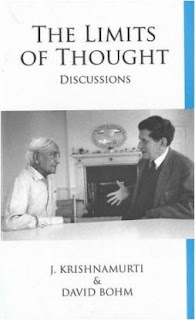
“Tradition is a form of brain damage” – is what physicist David Bohm and spiritual teacher Jiddu Krishnamurti agree upon in one of their dialogues in the book “The limits of thought”1. A few months ago I got an opportunity to facilitate a reading-and-reflection session on this dialogue and this sentence created discomfort among a few of the participants. They had valid points. Neither Bohm nor Krishnamurti was a neuroscientist. On what basis are they making such a claim? And neuroscience has advanced significantly in the last fifty years since they had this dialogue. Does it support it now? Let’s explore it in this article.

Let’s begin with the dialogue and then look at it through a neuroscience lens. Here is an excerpt from the dialogue:

DB: It occurred to me that tradition is a form of brain damage.

JK: I agree.

DB: Any tradition, good or bad, makes people accept a certain structure of reality, very subtly, without their realizing they are doing it, by imitation, or by example, or by words, just by statements. So very steadily the child builds up an approach in which the brain attributes things which are in the tradition to a reality which is independent of tradition. And it gives it tremendous importance. Tradition has real effects of all sorts, which may even be valuable in some ways. But at the same time it conditions the brain to a reality, which is fixed.

A person may look at that reality and say, “That’s reality, I‘ve got to keep my feet on the ground.” But this ground has been created by tradition, by thought; it is no ground, it has nothing under it at all. It is sustained and nourished by this damaged brain, which is unable to get out of that circle.

Now, let’s turn to a current neuroscience perspective.

Typically, we associate brain damage with some kind of lesion, some physical damage to the structure of the brain. However, that is a limited view of brain damage. According to Karl Friston, a leading neuroscientist, there are two kinds of brain damages2. One is anatomical and the other is functional. He uses radio as a metaphor to illustrate the difference. Anatomical damage is like cutting off the wires in radio, while functional damage is equivalent to transistors becoming dysfunctional. A transistor is dysfunctional when the message passing through the wires gets broken. In neurobiology, such a failure is called neuromodulatory failure when the messages passed through neural synapses are not gated and/or weighted properly. This results in loss of gain control meaning loss of control in excitation and inhibition of various signals.

As Friston articulates, when the gain control is broken, it results in strengthening false beliefs because the inferences based on the sensory information get compromised. For example, should I carry an umbrella today? This question would be answered based on the weather forecast and the likelihood of rain. When beliefs become rigid, the information passing mechanism becomes dysfunctional and incoming information related to rain is either suppressed or considered unreliable similar to a transistor malfunctioning. So I may end up carrying an umbrella no matter what.

Perhaps what Bohm-Krishnamurti are suggesting is that tradition has the capacity to make certain beliefs so strong that they are no longer amenable for update based on contextual information such as weather forecast. Beliefs related to what dress to wear or not wear, what to eat or not eat, what rituals to carry out, whom to marry or not marry may become so rigid that they suppress the passage of contextual information.  They are treated as true and fixed no matter what. As far as certain beliefs are concerned, the brain becomes dysfunctional, fixed, and context-insensitive.

Thus tradition may cause functional brain damage. What Bohm-Krishnamurti say in the dialogue is that the damage may or may not be permanent. What could heal such damage? Krishnamurti suggests that perception or insight into the whole belief structure, its rigidities and how it is operating, in the form of thought, being stuck in a grove, may heal the brain. I am not aware of any scientific research supporting such a claim. However, work such as that of Catherine Kerr, supports a milder form of this claim. That is, a practice of shifting attention away from thinking into body sensations and breathing may result in making the neuromodulation mechanism more flexible. That is, it may improve the quality of information flow through the neural pathways.

Source:

1.      “The limits of thought”, J. Krishnamurti and David Bohm, Krishnamurti Foundation India, 2013, chapter 5 “Tradition and truth”, page 84. This dialogue happened on August 6, 1975, in Gstaad, Switzerland.  Bohm suggests that “Tradition is a form of brain damage” at 6:13 in the audio

2.      Dysconnection hypothesis of schizophrenia”, August 10, 2017, In this video Karl Friston explains the nature of mental disorders and the possibility of a therapeutic cure of schizophrenia.

Friday, February 25, 2022

Neuroscience of mindfulness: My 4 takeaways from Catherine Kerr perspective

Catherine Kerr (1964-2016) was an American neuroscientist who made important contributions to the neuroscience of mindfulness. Her research was focused on the relationship between the material processes in the brain and the body awareness practices like mindfulness, tai chi and qigong. I found her work interesting because of three reasons. One, she had a cautious attitude towards the tall claims attributed to mindfulness. “Don’t believe the hype,” she said while also mentioning, “Behind the hype, there is some truth”. Two, I found her work on brain rhythms especially alpha waves and their relationship to mindfulness intriguing and relatable. And, three, she was trying to balance quantitative research from brain imaging studies with qualitative research from personal diaries and narratives. In this article, I would like to present my 4 takeaways from Cathy’s perspective. They are related to attentional freedom, brain rhythms, body-brain information loop, and existential reorientation.

Regaining attentional freedom: For many of us, attention is primarily consumed by repetitive thought patterns. Cathy calls this state of mind ungrounded. “Some people don’t even know that they can shift their attention in their body,” she says1. Mindfulness begins with learning to shift attention out of thinking into body sensations. This is what Cathy calls learning to regain attentional freedom2. “When mind lands in the body, you really feel it”3. This is the first step for many of us who tend to be dis-embodied. Cathy feels that people with chronic pain don’t have attentional freedom4.

When attention shifts from ruminating thoughts like “I am not good enough” to present moment sensations there is a different circuit in the brain that gets activated5. Anxious rumination activates the medial prefrontal cortex, also called the default mode network. And present moment awareness activates the lateral prefrontal cortex. Activation of these two circuits is found to be anti-correlated.

Alpha waves as volume control knobs: “How does a practice that begins by paying close attention to the toe reduce negative thoughts?” This is how Cathy introduces the research question she explored6. Her subjects, the treatment group, underwent the 8-week Mindfulness-Based Stress Reduction (MBSR) program. Her findings suggested that the thalamus and associated circuits act as a gatekeeper for various signals and alpha rhythms, brain waves of frequency around 10Hz, act as volume control knobs. For example, currently, as I am sitting in front of a laptop, there is sensory information coming in from my butt on the chair, visual input from the laptop screen, auditory input from surrounding sounds, thoughts related to this blog, etc. Alpha rhythms regulate these signals and block the signals it considers non-relevant in the current context.

When we become dis-embodied and attention is taken up mostly by thoughts, alpha rhythms become inflexible and tend to suppress bodily signals. What Cathy found out is that after 8-weeks of BMSR practice which involved paying attention to bodily sensations, alpha rhythms became more flexible in a statistically significant way. This flexibility extends to other signals as well. That is, learning to be mindful of the body teaches you to be mindful of the other sensations, thoughts and feelings7. Her research also found out that people with chronic pain have inflexible alpha rhythms and they lose access to body-space.

Cathy also mentions that meditators sometimes report feeling cortical rhythms and palpable sensations in other body areas. For me, feeling some kind of tingling sensation in the head, and in other body areas but especially in the head is common. Could that be alpha rhythms? Who knows?

Body-brain information loop: When we hold a cup or an egg in hand, the brain sends motor commands to the hand that moves the muscles. When the egg is held sufficiently tightly, the hand sends information back to the brain telling, “No more motor commands, I have taken in enough of information.” Thus, there is a circular information flow from brain to body and vice versa. This information flow from hand to the brain can be measured by looking at the beta rhythms which are stopping rhythms. Traditionally, scientists have studied these rhythms to understand what is flowing from brain to body. But Cathy’s research looked at the information flow from muscle spindle neurons back to the brain8

Her hypothesis was that when we are more embodied i.e. our awareness extends into our body, the quality of information sent back from the body to the brain is better. Apart from beta rhythms, Cathy also looked at clinical markers in fatigue called inflammatory cytokines9. For this research, Cathy decided to focus on distressed cancer survivors because many of them tend to be actively fatigued for years. They don’t have the energy to do exercise. However, they may be able to do slow body awareness exercises like tai chi and qigong. Cathy was a cancer survivor herself for two decades and a practitioner of these Chinese practices.

Cathy felt that mindfulness needs to be taken “off the cushion”10. Mindfulness is not only about doing a seated meditation. It can happen while you are moving. “Mindfulness on the go” has been an important aspect of my workshops and hence this aspect is interesting to me.

Existential reorientation: During her brain imaging research with the 8-week mindfulness program practitioners, Cathy also looked at the daily journal of some of the participants. And, she was surprised to find that most of them went through a lot of distress during weeks 4, 5 and 611. Participants experienced a feeling of insecurity. Some felt like quitting and moving to the Bahamas. Some of them felt like quitting the program. And in weeks 6, 7, and 8 participants began to settle into a positive trajectory. This led to a new hypothesis that perhaps somatic awareness in the longer-term leads to an existential reorientation i.e., re-construction of self-image12. Self-image has multiple dimensions e.g., bodily self, volitional self, narrative self, social self, etc. Self-image change includes changes to the body’s representation in the brain. She mentioned that this is just a hypothesis and yet to be tested.

From my personal experience and through the interaction with others, it is not at all uncommon to see existential reorientation. Am I an independent entity trying to be in control of the situation? Or am I deeply connected with the world with an illusion of control? Questions of these sorts are common in mindfulness exploration. Are there any associated mechanistic changes to the cognitive processes when the existential orientation changes? It will be interesting to see.

As you can see, many of the questions that Cathy asked haven’t been answered conclusively. However, I liked the questions themselves and I am sure they will have a life of their own.

Sources:

1.       Episode 56: Embodied cognition and its effects on health with Cathy Kerr”, a podcast interview by Brook Thomas, May 31, 2016 (time stamp: 13:40)

2.       Starting with the body: the neuroscience of somatosensory attention”, a talk by Catherine Kerr at Amherst College, Nov 11-13, 2011 (Cathy talks about attentional freedom at 28:53)

3.       Episode 56” (14:35)

4.       Starting with the body” (28:58)

5.       Starting with the body” (6:20)

6.       Mindfulness starts with the body: A view from the brain”, TEDx talk by Catherine Kerr, May 22, 2012 (3:00)

7.       Starting with the body” (16:40)

8.       Episode 56” (Cathy talks about beta rhythms and the information flow at 43:55)

9.       Episode 56” (Cathy talks about the clinical markers of fatigue in blood at 27:00)

10.   Episode 56” (17:50)

11.   Using qualitative methods in mindfulness studies to contextualize brain data”, talk by Catherine Kerr at UC Davis, May 21, 2015. (18:30)

12.   Using qualitative methods in mindfulness” (20:20)

Saturday, June 5, 2021

My key takeaways from Katha Upanishad

Investigating the “illusion of time” hypothesis is an important part of the mindfulness process and I explore it in chapter 7 of my mindfulness book. In Sanskrit and in many Indian languages the word kaal (काल) means both time and death. Hence, Katha Upanishad (or Kathopanishad) which contains a dialogue between Nachiketa, an inquisitive boy and Yama, the God of death has been of interest to me. I had read the English translations a few times. Last year, I tried to read it in Sanskrit. I used the Sanskrit online dictionaries and also listened to 30 of 47 discourses by Swami Tejomayananda of Chinmay Mission last year. Here are my key takeaways from what I have read so far and what my understanding is of these verses. I am sure, like any art form, I might find new meanings and nuances when I read it again.


1.      What is the state of the world?

Verse: 1.2.5

अविद्यायामन्तरे वर्तमानाः स्वयं धीराः पण्डितं मन्यमानाः ।
दन्द्रम्यमाणाः परियन्ति मूढा अन्धेनैव नीयमाना यथान्धाः ॥ ५ ॥ 
 
avidyāyāmantare vartamānāḥ svayaṃ dhīrāḥ paṇḍitaṃ manyamānāḥ |
dandramyamāṇāḥ pariyanti mūḍhā andhenaiva nīyamānā yathāndhāḥ || 5 ||

Living in the middle of ignorance and regarding themselves as intelligent and learned, the ignorant go round and round, in many crooked ways, like the blind led by the blind.


2.      Why is the world like this?


पराञ्चि खानि पराङ्पश्यति नान्तरात्मन् । (part of verse 2.1.1)
parāñci khāni parāṅpaśyati nāntarātman |

Sense organs are out-going. Therefore, one sees outside and not the atman within.

And the first line of the next verse (verse 2.1.2) 

पराचः कामाननुयन्ति बालास्ते मृत्योर्यन्ति विततस्य पाशं ।
parācaḥ kāmānanuyanti bālāste mṛtyoryanti vitatasya pāśaṃ | (verse 2.1.2) 

The ignorant pursue external objects of desire; they get into the meshes of widespread death.


3.      What is futile?

Part of the verse 2.1.2 tells what is futile:
ध्रुवमध्रुवेष्विह न प्रार्थयन्ते

dhruvamadhruveṣviha na prārthayante 

(Wise) do not wish for permanence from that which is impermanent.


4.      What to do? (1)


आवृत्तचक्षुः (āvṛttacakśuh)i.e. Turn eyes (attention) inwards (Part of verse 2.1.1)

And observe that (verse 1.3.10)


इन्द्रियेभ्यः परा ह्यर्था अर्थेभ्यश्च परं मनः ।
मनसस्तु परा बुद्धिर्बुद्धेरात्मा महान्परः ॥ १० ॥

indriyebhyaḥ parā hyarthā arthebhyaśca paraṃ manaḥ |
manasastu parā buddhirbuddherātmā mahānparaḥ || 10 ||

Meaning is superior to the sense organs, underlying tendencies or beliefs are superior to the meaning, discerning intelligence (vivek-buddhi) is superior to the beliefs and underlying essence (atman) is superior to the intelligence.

5.      What to do? (2) 

Verse 1.3.14

उत्तिष्ठत जाग्रत प्राप्य वरान्निबोधत ।
क्षुरस्य धारा निशिता दुरत्यया दुर्गं पथस्तत्कवयो वदन्ति ॥ १४ ॥
uttiṣṭhata jāgrata prāpya varānnibodhata |
kśurasya dhārā niśitā duratyayā durgaṃ pathastatkavayo vadanti || 14 ||

Arise, awake; having reached the great, learn; the edge of a razor is sharp and impassable; that path, the wise say, is hard to go by. 


My summary: Wake up, are you pursuing only external objects? Are you leading a meaningless life? Are you wishing permanence in impermanent? Turn your attention inwards and watch the subtle movement of thought. Are you reactive all the time? Is there any discernment i.e. questioning of beliefs? Be alert and watch.

Image source: karunagyoga.in