Thursday, May 29, 2014

3 tools I find useful as an innovation catalyst

Over the last seven years, I have been doing my bit in helping my clients innovate more effectively. Their business domains varied from apparel design to aircraft design and from software product development to educational services in social sector. During this journey I ended up using a number of tools – perhaps over fifty. However, I have developed special friendship with some of the tools – primarily due to their usefulness under varied contexts. Here I would like to present 3 such tools which I find very useful in almost any context.

Weighing scale: I am a big fan of weighing scale as a metaphor. It is simple, easily accessible and provides emotion-proof feedback. You weigh the same no matter how angry you are. In contrast, a report based on an annual survey is typically neither simple, nor that easy to re-create and incorporates emotional biases. I suggest innovation dashboards and also get my clients into a dialogue on 5-levels of innovation maturity which are more like weighing scales. Not everybody in the room may agree on whether they are at level 2 or 3 on innovation maturity. However, it creates a useful discussion on what they can do next. For example, if the key challenge is that the average response time for an idea is more than a month, a discussion happens around what can be done to reduce it.

Bright-spot torch: A torch is useful in focusing the attention to a specific area. I use a special type of torch which helps me focus on bright-spots in the organization. Bright spots are things that are already working well in some corner (e.g. see how bright spot led Steve Jobs to iPod). A few weeks back I facilitated a session on writing technical white papers in a client organization. As part of the preparation I tried to gather the technical papers written by the employees in the organization in recent past. None was identified. However, when I asked the same question during the session, one hand got raised. In fact, he told us the story of how he went about preparing for the paper which everybody found useful.

Bright spots are useful because they can tell us a lot about how things work in the same cultural context. They inspire and also give direction. Bright spots are not easy to find because they typically don’t bubble up through status reports. Whether it is interesting prototypes or big bets related to specific technology trends (like cloud or humanoids), chances are high somebody in some corner is working on it or at least thinking about it. Can we zoom in there and find more about it? Perhaps the situation is scalable.

Checklist: Intuition works great when we are doing things we are familiar with. However, when we are trying to change mindset, intuition is not very helpful. Sometimes people are not used to submitting ideas, managers are not used to listening to ideas with an open mind, and senior managers are not used to participating in innovation reviews. In such situations I find checklists very helpful. I propose a checklist whether it is a challenge campaign or an innovation review or even a white paper to be written. For example, here is a sample checklist for running a challenge campaign and here is an author’s checklist for writing a white paper. My customers find it useful. In fact, I have earned some brownie points by creating a checklist for groceries which we use at home. A checklist is more helpful when intent to improve things exists. You need different set of tools to generate intent (e.g. a challenge book). It is not surprising that each chapter in our book “8 steps to innovation” has a checklist at the end.
Monday, May 26, 2014

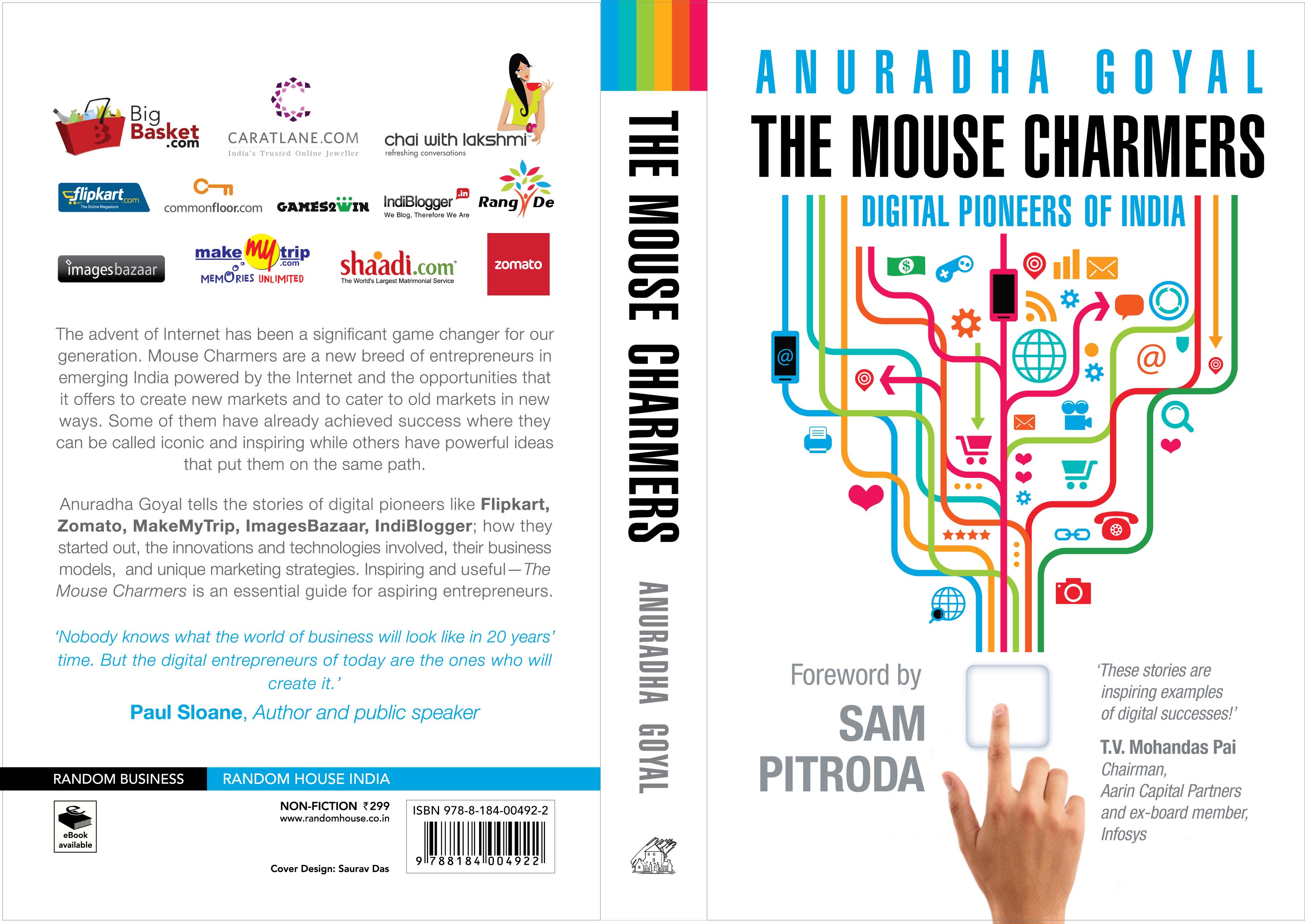
Mouse charmers by Anuradha Goyal: A book review


If you live in India, chances are high you are familiar with companies like Flipkart, Makemytrip.com, shaadi.com. Like me, you might have bought books from flipkart and booked tickets from Makemytrip. You might have paid using cash-on-delivery. And that may give you a feeling, “Oh, I know how this business works”. But, do you really know how these businesses really work? Anuradha Goyal points out in her debut book “The mouse charmers: Digital pioneers of India” – The devil lies in the details. Do you know how Flipkart uses A/B testing framework to perform dozens of experiments at a time? How Zomato manages to keep its menu updated? On an average, how much does it cost Games2win to develop a new online game? Anuradha brings out such details and much more through the stories of 12 digital pioneers of India. Here are 3 things that I liked about Anuradha’s book: (Note: Anu is a friend of mine and hence this review will carry a natural bias).

Broad canvass: Amazon, Google and Yahoo are all Internet players. However, they are fundamentally different businesses. Amazon is an e-commerce player, Google is primarily a connector and Yahoo a content provider. Anu uses this categorization (commerce, content and connectors) to cover a broad canvass of Internet players from India in this book. Apart from the big daddies like flipkart, it also has smaller players like ImagesBazaar, Games2win, Chai with Lakshmi. It covers commodity players like BigBasket (online grocery) and it also has luxury players like CaratLane. Two sectors which are conspicuously missing are healthcare and education. Reason is obvious – these are still in a nascent form. If we go by the buzz around where Venture Capitalists (VCs) are investing today, picture is likely to be different a few years from now.

Business model emphasis: The part of the book which I found most interesting is Anu’s abstraction of the business model for each player and emphasizing the components that are most crucial in that business. A content player like Zomato has a very different business model than a Flipkart or Makemytrip. For example, for Zomato, keeping the menu card updated is most important. It means visiting its 1,00,000 restaurants every 90 days. That’s a significant investment! For BigBasket.com which delivers perishable items within hours of order, logistics management is one of the most crucial elements. Given the chaos on the roads of the Indian metros, how do you do it? Currently, BigBasket delivers in 4 slots during the day, 2 in the morning and 2 in the evening. Anu highlights various business model templates like Freemium, Media model (Zomato), SNAP (Studio, Network, Application and Portal – Games2win) used by the players.

What are they doing differently? Each player is trying to do various things to differentiate itself. Flipkart is using analytics in presenting live statistics, identifying sudden spikes in orders and taking policy decisions such as the minimum purchase price for free shipping. For Makemytrip it is the route planner, CaratLane’s emphasis on educating customer on how to judge a diamond etc. For many players technology platform is a differentiator and some cases Anu’s goes into more details to present the broad architecture of the platforms.

Here are two perspectives I feel the book could have done better on:

Financial perspective: For any budding entrepreneur, it is important to know how much investment is needed, how did these guys source the capital, how much did they put from their pocket, how long did it take to become profitable, how much is the typical margin etc. An important dimension is to provide VC perspective – Who all are the players who invested in these companies? At what point of time in their journey? How much? Etc. Not much is available in the stories.

Failed experiments: What did work is indeed useful. However, what didn’t work is equally if not more useful. Unfortunately, such information is not easily available especially in Indian context. Anu has tried to present this data wherever she was able to get it. In fact, Games2win has explicitly listed failed experiments in its website. However, not much of this is present.

Overall, Mouse Charmers presents an excellent overview of the digital landscape of India. I am sure budding entrepreneurs will find this book useful. The scene is changing fast but business models are re-usable. I admire Anu for wearing multiple hats at the same time – travel blogger, book reviewer, innovation consultant. With this book she adds another feather in her cap. I wish the book success.

Thursday, May 1, 2014

1996 Everest disaster and a lesson in “design as if implementation matters”

When I finished reading “Into thin air: A personal account of the Mt. Everest disaster” by Jon Krakauer a couple of weeks ago, it was still considered the worst Everest tragedy. It is a story of a disaster that happened on May 10 and 11, 1996 on Mt. Everest in which eight people died in a single storm including two expedition leaders: Rob Hall and Scott Fischer. However, as I am writing this blog, it is no longer the worst tragedy. Friday before last, on April 18, sixteen Sherpas got killed in an avalanche. Climbing Mount Everest continues to be a risky affair and no amount of learning is likely to completely eliminate the risk. In the words of Krakauer - On Everest, it is a nature of systems to break down with a vengeance. That doesn’t prevent people like me in deriving learnings from the 1996 disaster story. Here is my key take-away from “Into thin air”.

Rob Hall was world’s leading Everest guide running a company “Adventure Consultants”. By 1995 Rob had assisted thirty nine clients reach the top of the mountain and return back safely. In 1996 May expedition his team had clients some of whom had paid as much as sixty five thousand dollars in order to get to the world’s tallest peak.

Rob was disciplined and meticulous. He had fine-tuned an effective acclimatization plan that would enable the team to adapt to the paucity of oxygen as you go up. Rob knew that timing is crucial in Everest expeditions. He lectured the team repeatedly about the importance of having a pre-determined turnaround time on the summit day. It would be 1pm or worst case 2pm. Everybody was to abide by it no matter how close one was to the peak. “With enough determination, any bloody idiot can get up the hill,” Rob would say, “The trick is to get back down alive.”

On the summit day, Rob reached the summit after 2pm and waited for his team member Doug Hansen to reach the summit till 4pm before they began their descent. Doug was so tired by the time he reached the top, he didn’t have much energy left to come down. As luck would have it, he ran out of his oxygen too. Both Rob and Doug got caught in the storm that followed and didn’t make it down. How could a disciplined expedition leader like Rob Hall make such a mistake of not adhering to a predetermined turnaround time?

As Krakauer writes in the book: Lucid thought is all but impossible at 29,000 ft. In addition, the intensity of the desire of achieving the goal – for you and for your clients - is much higher than the cold-blooded process adherence and turning back at 2pm. In short, your thinking is heavily biased. But equally importantly, it is known apriori that your thinking is going to be crooked as you climb up. Then why not plan taking into account such a possibility? Is it possible to create a plan that accounts for the distorted thinking during its implementation? This is the central question when you want to “design as if implementation matters”. To use the Elephant-Rider metaphor of the mind, it is like the Rider planning for a situation when the Elephant has taken over. How do we do it?

Here are a few options none of which is fool-proof: One, responsibility of the turnaround decision can be delegated to a place where the mind is less emotionally charged and has more oxygen e.g. the base-camp or camp-one. Two, after the predetermined turnaround time, everybody coming back takes the responsibility of requesting the up-going climber to turn around, despite your position in the pecking order.

Three, each expedition team performs pre-mortem before the expedition begins.  In this exercise everybody in the team imagines a situation in the future when the project has been a massive disaster. In Everest expedition, it means imagining your own body lying around 28,000 ft and several other casualties. And then listing down what all went wrong. That leads to various precautionary measures and a common understanding of the importance of a protocol such as turnaround time.

“Design as if implementation matters” has significant implications for the design of business strategy.  A strategy which gets finalized in an offsite in cosy settings may fail to take into account the emotional biases of the team during its execution – just like Hall’s Everest team.

No amount of planning can eliminate the risk in Everest expeditions or in business. However, techniques such as pre-mortem may help increase the “Margin of safety”.

A related video
Mt. Everest - The storm (1996) - A PBS  documentary on the 1996 disaster directed by David Breashears, one of the members of the IMAX team who climbed Everest during the same season and also helped the teams caught in the storm. 

Thursday, April 17, 2014

Highlights from Swami Chidananda’s talk: Learning from the book of life

I got an opportunity to attend a talk by Swami Chidananda, a spiritual teacher, in Mumbai on March 9, 2014. Two things took me to the talk: One, I found the title interesting – “Learning from the book of life” and two, it was organized by Krishnamurti Foundation India (KFI) of which my father has been an active member. It was nice to give him company and meet his friends from K-community.

I enjoyed the talk and this article gives a few highlights from the talk that appealed to me. This is derived from the audio recording of the talk made available to us by Fowai – Swamiji’s organization. I am thankful to Vibhaji for sending the audio CD. I have kept the wording as close to Swamiji’s talk as possible.

What is learning from the Book of life?  There was an Army General who deliberately used to come home late. When he was asked, “Why do you go home so late?” He said, “In my job, thousands if not tens of thousands are afraid of me. But at home I am afraid of my teenage son. Some of the comments he makes e.g. ‘Dad, you won’t understand this, you are out of touch with reality,’ make me miserable. I feel, may be he is right.” Like this Army General, we feel comfortable in some situations and uncomfortable in some other situations. Some places we get attached, some other places we feel “fish out of water”. What is going on? Instead of reading big books on Atma, Brahma, Heaven & Hell, concepts of liberation, bondage, 24 tatvas and 36 principles, is it possible to learn about our reactions to variety of situations directly from our life experiences?

Tragedy of bookish knowledge: Knowledge of symbols and concepts helps us in various contexts. For example, if power suddenly fails here and one of you knows very well how to handle mini circuit breakers or fuses and then you quickly go there and open and set something right. And the power comes back. Of course, many others will thank you. “Oh, how nice you are with us today, you set it right immediately,” people will say. In that context, the knowledge of electricity helped you. Similarly, knowledge of languages, etiquette helps in certain contexts.

But does knowledge help in deeper inner freedom where we suffer from a number of self-created blockages, self-created mental hang-ups? The tragedy of bookish reading is, instead of understanding what you are going through, you are trying to remember, “What did the author say about this kind of scenario?” If you read a book on anger, when you actually get angry, you don’t think of the book at all. You go about your response in a mechanical way, in a habitual way. This habit, this mechanical way is to be tackled.

Over-investment of I, me, my: Suppose I happen to be a Bengali speaking person and I say, “There are 3-4 Bengali speaking people here. Let me go and know them.” This is alright. But imagine if my mind also says, “You see, others may feel bad to hear this, but Bengali is the best language”. You ask me, “But have you studied other languages?” I say, “No. But I know my language is the best.” “My food habit is the best,….” That is called psychological domain. This is the place where “I, me, my” is over-investing in certain conclusions –positions. Can learning from the book of life help us to be free of these conditionings?

How to learn from the Book of life:  The way to be free is to look at our conclusions right when they arise, not even in a post-mortem fashion, towards the end of the day. Like a dying duck, you analyse your day before you go to sleep, “Today, during the day, what did I do? What were the highlights? How did I treat people?” Such introspection has serious limitations. Can you examine a judgmental behaviour on your part right when that behaviour is taking place? For example, some of you may be feeling bored listening to this talk. Is it possible for you to take a look at what is going on in your thought process and look at it dispassionately? On the one hand you are looking at your thought, your emotion. On the other hand, you should not be in a hurry to label it. This is a very interesting science where the book from which you are learning is your psychological process.

Precious pages of the Book of life: Negative emotions are the precious pages of the book of life. You and I learn the operation of the self much more when we are disturbed, depressed, when we envy somebody or when we are afraid.

Can I stay with fear, look at it with all alertness? If you are not alert, then you start thinking about something else, “Whom shall I call to help me? I wonder how long will the fear last?” or “This fear is stronger than last time.” etc. These are all secondary thoughts, secondary considerations. Primary consideration is, “Here is fear. What is it?” The objective is to use this tool of attention or alertness without succumbing to or getting caught in all those this-fear-is-stronger-than-before kind-of secondary engagements. Not even saying, “This is undesirable.”

To understand fear there is absolutely no need to bring the past into picture. The fear that is rising in you has everything in it like in hologram a part has everything in it. The fear of which we become intensely aware without bias, without noise of conditioned mind reveals its entire structure.

To conclude, reading the book of life is nothing different from living in self-awareness. If you become aware of what bothers you, what delights you, what is going on in your mind or if you become aware of getting inattentive then you are already reading the book of life.

Related article: Eckhart Tolle’s “Catch me if you can” experiment, Feb 2, 2014.
Photo: From the audio CD of the talk.

Tuesday, April 8, 2014

Responding to team member’s idea using 3 types of inquiries

Imagine you are a manager and a team member comes to you one day and says, “I have got this great idea!” There are multiple ways you may respond to this situation. You may say, “Tell me more…” and after listening to his initial blurb you may ask, “Why this approach?” or if you have a better idea, you may ask, “How about this instead?” Depending upon the context all three responses may be relevant. However, Prof. Edgar Schein shows in his new book “Humble inquiry: The gentle art of asking instead of telling” that the three inquiries, in fact, belong to three distinct categories of inquiries. Schein argues that managers today need to do a lot more of “Tell me more…” type of inquiry than “How about this instead?” type of inquiry if they want to build trusting relationships.  Before we understand why Schein says this, let’s first see what the three types of inquiries are.

Humble inquiry: What is a humble inquiry? According to Schein, a humble inquiry has 3 characteristics (1) It demonstrates genuine curiosity (2) It makes least number of assumptions about the idea and (3) it is followed by attentive listening. Apart from “Tell me more…”, other examples of a humble inquiry are: “So…” (with an expectation look), “What’s happening?”, “What’s going on?”, “What brings you here?”, “Go on…”, “Can you give me an example?” Asking the right question is not the most difficult part of humble inquiry. Attentive listening is. If you try to fake the question, it will show up when you listen. Why? Because it is not easy to keep your preconceived notions aside and listen to what the other person has to say. Let’s contrast humble inquiry with two other categories of inquiries.

Diagnostic inquiry: The second question the manager asked in the first paragraph, “Why this approach?” belongs to diagnostic inquiry. It is a type of inquiry where you steer the conversation in a specific direction by inquiring about feelings, reactions, causes, motives, next steps, previous steps etc. Through diagnostic inquiry you are influencing the mental process of the other person in an unknown way. Examples of diagnostic inquiry are: “How do you feel about that?”, “Why did you feel that way?”, “What may have caused this?”, “What have you tried so far?”, “What are you going to do next?” In this type of query, you take charge of the process but not the content.

Confrontational inquiry: The essence of confrontational inquiry is that you insert your own ideas in the question you ask. The third question in the first paragraph, “Why not this instead?” belongs to this category. Essentially the question has your agenda embedded in it – either knowingly or unknowingly. Examples of confrontational inquiries are: “Did that not make you angry?”, “Do you think customer will it like it this way?”, “Have you thought of …?”, “Were the others surprised?” In this type of query, you take charge of the process and the content. It is the hardest type of query to build trusting relationship.

Now, let’s come back to the question as to why Schein advocates humble inquiry. Well, whether you are a lead surgeon in an operation theatre or a delivery manager in a technology company or a CEO of an organization, you depend significantly on your team members (nurses, engineers, employees etc.) It is no longer sufficient to get things done by being “task oriented” – you do your job and I do mine and we will be fine. It is important to form trusting relationships to achieve results. Relationships are the key to good communication and good communication is the key to successful task accomplishment. Hence, Schein emphasizes “ask and listen” to “do and tell”.

How can we use this while responding to a team member’s idea? Let’s borrow three-hats approach analogy of David Packard. First, wear the “Humble inquiry” hat and ask clarification/example type of questions. Then wear the “Diagnostic inquiry” hat and see how he has arrived at this idea, what has he tried etc. And finally, wear the “Confrontational inquiry” hat before making the final decision.

Related articles:

A humble inquiry that led to a successful culture change initiative, April 7, 2014

Monday, April 7, 2014

A humble inquiry that led to a successful culture change initiative

Many times culture change initiatives are articulated at an abstract level. e.g. ‘We want to foster a culture of innovation’. The intent is good but the abstractions don’t help much in bringing about a change in the behaviours. In such situations, asking simple clarification questions – what Prof. Edgar Schein calls humble inquiry – can make a big difference. Here is a story Schein narrates in his new book “Humble inquiry: The gentle art of asking instead of telling”. It articulates how a humble inquiry might take the intent of culture of change forward in the right direction.

A CEO of a power company wanted Schein to help launch a culture change project. The CEO felt that the organization was stuck in an old and obsolete set of practices. He wanted Schein to diagnose the problem and propose a change roadmap. At this point, Schein didn’t know anything about the organization, CEO’s perceptions or his motivations. Hence, Schein invited him for a meeting to define problem. CEO brought COO and the VP organization development along with him.

The discussion began by the three leaders launching into a series of general statements about how the culture of the company was immovable and stuck. Both “immovable” and “stuck” are abstract terms. Hence, Schein felt it is best to clarify what they meant. So he asked for an example.

The COO narrated following story as an example. The previous day he had a staff meeting of the 15 member leadership team. There were only five members present for the meeting. However, they sat in exactly the same chair even if it meant sitting far away from each other. He concluded, “It was really crazy… you see what we are up against?” Then the COO looked at Schein for affirmation and support. Schein became curious about what happened next. He asked, “What did you do?” He said, “I didn’t do anything.”

At this point a huge light bulb went off in the heads of all the three people. All of them realized that they are the ones who were reinforcing the so called “outdated” behaviours by their own inaction. Subsequently, the four of them explored other ways in which the old patterns were getting reinforced and how they could change their own behaviour. Over the next year they were able to make most of the culture changes that they desired.

When change initiatives are being discussed, simple questions like “Can you please give an example?” that bring out before-change and after-change scenarios concretely can go a long way in adding clarity. Also reinforcing new behaviours is as important as changing behaviours, isn't it?

Related articles:

Saying, “We need a culture of innovation” is mostly correct and useless, Sept 4, 2009

Sunday, March 23, 2014

3 lessons innovation leaders can learn from the iPod story

Walter Isaacson begins chapter 30 of the biography Steve Jobs titled “The Digital Hub” with a “What next?” workshop Jobs facilitated in 2001 where iPod idea got a push. However, as we read further into the chapter, we come across various events that influenced the decision making, shaped the idea and took it forward. Here are 3 lessons I feel innovation leaders (CXO, product managers, Biz heads, VCs) can learn from iPod story:

     1.     Strategic theme (“Digital Hub”): Apple introduced FireWire technology in 1999 that would help transfer video from cameras into iMac fast. The video could then be edited, mixed with music and distributed further. Seeing this Steve Jobs realized, “Using iMovie makes your camcorder ten times more valuable. That’s when it hit me that the personal computer was going to morph into something else.” Jobs would call that “something else” – “Digital Hub”. A side effect of PC becoming a hub was that it would create opportunity for personal devices to become simpler. Note that the source of the insight was an internal "bright spot" (i.e. iMovie-camcorder joint value creation) not a trend discussed externally. Digital hub would soon become the dominant theme during the brainstorms like the one mentioned above. I have facilitated “What next?” workshops for the past several years. Rarely do I come across a team or its leadership with clarity on strategic theme such as “Digital Hub”.

2.     Investment confidence ($10 million check): iTunes software was launched in January 2001. However, Jobs had started pushing for the portal music player idea a few months earlier – in the fall of 2000. At that time, Rubinstein responsible for hardware engineering, told Jobs that the right components were not available yet. During one of his regular supplier visits to Japan in February 2001, Rubinstein came across a tiny 1.8-inch Toshiba hard-drive with 5GB space. Toshiba engineers were not sure what it could be used for. Rubinstein realized its potential use in the portal music player. Fortunately, Jobs was also in Japan giving a keynote at the Tokyo MacWorld conference. That night he met Jobs at the Hotel Okura where Jobs was staying and said, “I know how to do it. All I need is $10 million check.” Jobs immediately authorized it. That was roughly 2.5% of the R&D spend at that time and R&D budget was around 5% of revenue. This demonstrates Steve’s investment confidence – not that easy to find at least in India.

3.     Business plan review (Experimentation focus): “There are certain meetings that are memorable both because they make a historic moment and because they illuminate the way a leader operates.” This is how Isaacson describes the iPod’s proposal review meeting in April 2001. Tony Fadell, a new joinee and a key brain behind iPod was the presenter and in the audience were Jobs, Rubinstein, Schiller (designer), Jonathan Ive (Head of design), Jeff Robbin and marketing director Stan Ng. It was Fadell’s first presentation to Jobs.

Fadell began his presentation with a slide deck on the potential market and existing players and soon realized Steve doesn’t like slides. Steve later told Isaacson, “If you need slides, it shows you don’t know what you’re talking about.” Fadell quit showing the slides and showed the three different models he had brought in to the conference room. Rubinstein had coached him on what order to reveal them so that his preferred choice is shown last and with a bit of suspense. The last mockup option was hidden under a wooden bowl at the center of the table.

Fadell took various parts out of a box and spread them on the table. These includes 1.8-inch drive, LCD screen, boards and batteries all labelled with their cost and weight. This was followed by a discussion around how the prices might come down in the coming year. Some pieces could be put together, like Lego blocks, to show options.

The models were made up of Styrofoam. The first one had a slot for removable memory card, the second one had DRAM memory which was cheap but user could potential lose all songs if battery ran out. Jobs didn’t like both of these models. The final model was shown by lifting the bowl and revealing the fully assembled model of 1.8-inch drive. Next Schiller demonstrated the trackwheel through a few models. Jobs shouted, “That’s it!” The decision was made and Fadell & co got working on the project immediately.
Fadell recalls, “I was used to being at Philips, where decision like this would take meeting after meeting with a lot of PowerPoint presentations and going back for more study.”

As an innovation leader ask yourself: (1) Do I have any strategic insight like the “PC as a Digital Hub”? (2) Am I willing to write a “$10 million check” for the strategic initiative when a “Rubinstein” shows up? (3) Can we emphasize experimentation (prototyping) in the business plan review over PowerPoint projections?

Source: Primary source of the story is chapter 30 of Walter Isaasson's biography Steve Jobs. Image source: en.wikipedia.org.
“Apple’s R&D spending hits bottom as percentage of revenue” by Larry Dignan, ZDNet.com, October 17, 2011. (has a table that gives Apple’s R&D as a percentage of revenue since 2000).